- Need the core difference? Start with PlayOn vs. StreamFab (2026): Cost, Quality, and Best Fit for the recorder, cloud recording, and local-file workflows
- Comparing everyday use? Check 2026 tech feature comparison of quality, files, playback, scheduling, and limits
- Deciding by budget? Review subscription & real cost analysis of recurring fees, credits, storage, and upfront cost
- Looking for a recommendation? Match user satisfaction of your device, viewing volume, and preferred file workflow
Choosing StreamFab vs PlayOn comes down to three practical questions: how long recording takes, whether cloud credits fit your budget, and whether the result is a playable local file. The quick takeaway is to compare the workflow first, then StreamFab cost and PlayOn’s recurring costs, and finally device fit.
This PlayOn Home vs StreamFab comparison starts with the workflow, then checks quality, playback, current pricing, reliability, and buyer fit. That order matters more than a long specification list because a convenient mobile recording and a desktop local-library workflow are not interchangeable.
PlayOn and StreamFab at a Glance
PlayOn Home records streaming playback on Windows, PlayOn Cloud handles recording through a mobile and cloud-centered workflow, and StreamFab saves supported streams to local files on Windows or macOS. That recorder-versus-local-file distinction affects speed, storage, transfer, and playback.
PlayOn Desktop is no longer supported. PlayOn Home and PlayOn Cloud are the current PlayOn options. How StreamFab works is different: it is a desktop alternative for saving authorized content for personal offline viewing, where platform terms and applicable law permit.
- PlayOn Home: Windows-based real-time recording with local MP4 output and a relatively low annual entry cost.
- PlayOn Cloud: mobile-friendly recording with credits and cloud storage before transfer to a device.
- StreamFab: Windows and macOS software for supported services, with local MP4 or MKV output and batch-oriented workflows.
My practical take is simple: decide where you want the work to happen first. A Windows recorder, a cloud queue, and a desktop local-file tool may produce watchable offline video, but they ask for different time, storage, and device commitments.

StreamFab vs. PlayOn: Features and Workflow
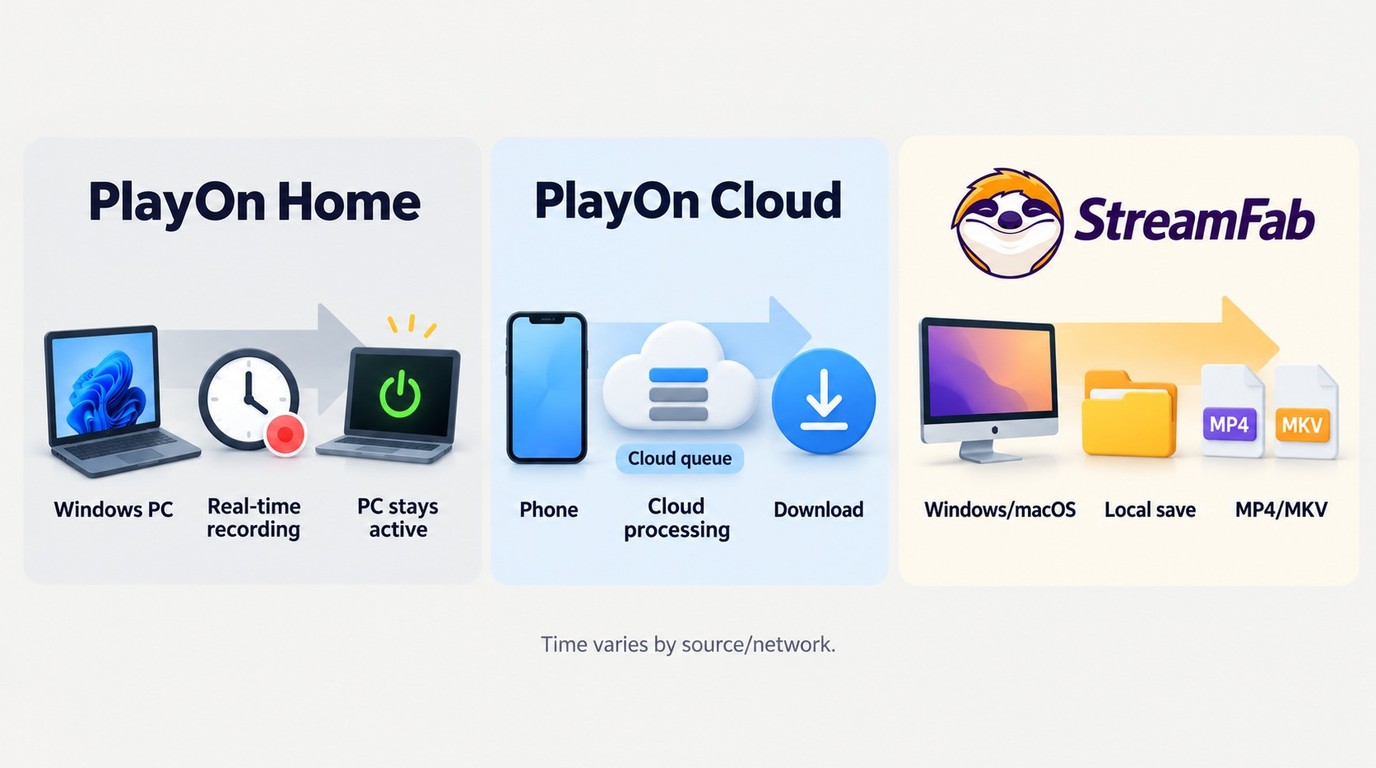
The main feature comparison is really a workflow comparison. PlayOn Home records in real time, PlayOn Cloud uses a credit-and-storage model, and StreamFab saves supported content as local files directly to the computer.
| Product | Method | Device role | File output |
|---|---|---|---|
| PlayOn Home | Real-time recording | Windows PC | Local MP4 |
| PlayOn Cloud | Cloud recording | Mobile request; remote processing | Downloaded MP4 |
| StreamFab All-In-One | Supported-service local saving | Windows or macOS desktop | Local MP4 or MKV |
Count rows only after you decide what matters. For a mobile-first request, PlayOn Cloud's remote workflow can outweigh local-format options; for a library that will move between desktop apps and media devices, local files and track choices matter more.
Output Quality and Playback
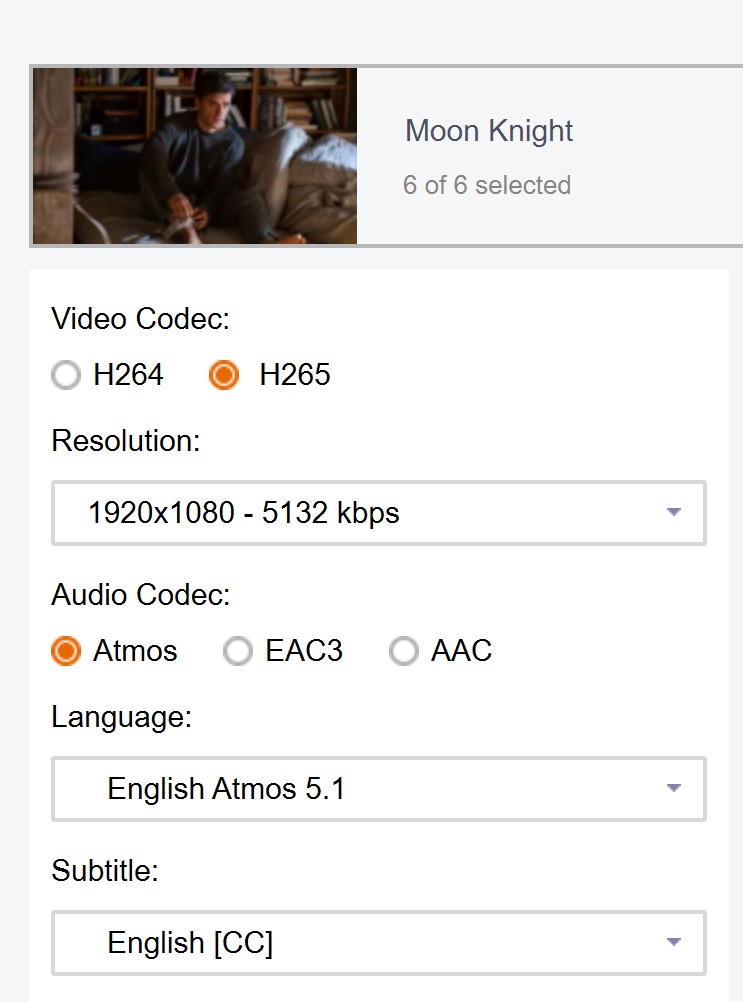
Quality depends on the service, selected plan, module, and source. PlayOn Home records at up to 1080p where supported. StreamFab supports up to 8K for eligible web sources, while supported subscription services have separate ceilings of up to 1080p or 4K based on the service and plan. HDR10 or Dolby Vision and multichannel audio are available only when the selected source, plan, track, and playback device support them.
The quality options returned for a specific title matter more than a bundle-wide maximum. Before building a queue, save one representative title and confirm its resolution, motion, audio, and subtitle playback on the intended device.
For large-screen viewing or a library that depends on subtitles and multichannel audio, prioritize the actual track and display options returned for the title. For casual mobile viewing, convenience may matter more than the highest available setting.
Ads and Offline Viewing
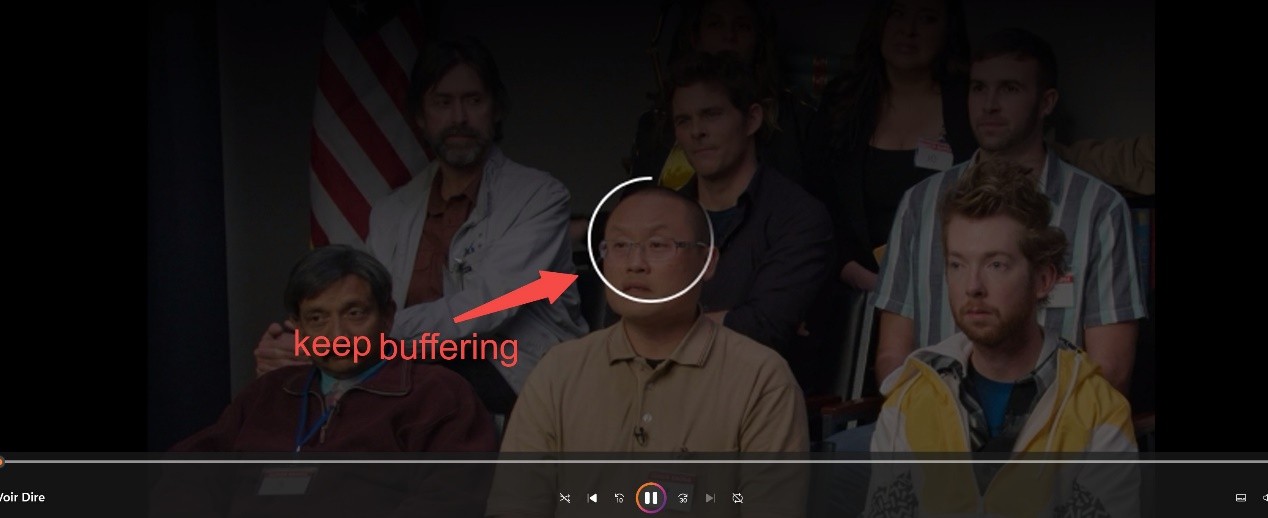
Neither product should be described as universally ad-free. Ad handling varies with the streaming service, account plan, title, and workflow, so an ad may be skipped, omitted from a supported save, or remain in the output.
Because ad handling can change by title and service, check one representative full-length video before adding an entire season to the queue.
Scheduling and Batch Tasks
Both workflows support automation, but the time model differs. A PlayOn schedule reserves real-time recording work, while StreamFab supports batch and scheduled local-saving tasks on supported services.
A newly watchable episode may not be selectable for saving immediately. When availability lags behind release time, the StreamFab update history provides the relevant compatibility information.
For an overnight season workflow, I would choose based on the bottleneck: PlayOn Home if a Windows PC can remain available, PlayOn Cloud if remote convenience matters most, or StreamFab if local batch output and track selection are priorities.

Speed and Resource Use
PlayOn Home records in real time on a Windows PC. PlayOn Cloud processes the recording remotely before the file is downloaded, while StreamFab saves supported content locally on Windows or macOS, with completion time affected by the source and connection.
That difference affects daily use more than a peak-speed claim. I would use PlayOn Home when a Windows recording machine can remain available, PlayOn Cloud when shifting the work off the device matters most, and StreamFab for local batch workflows.
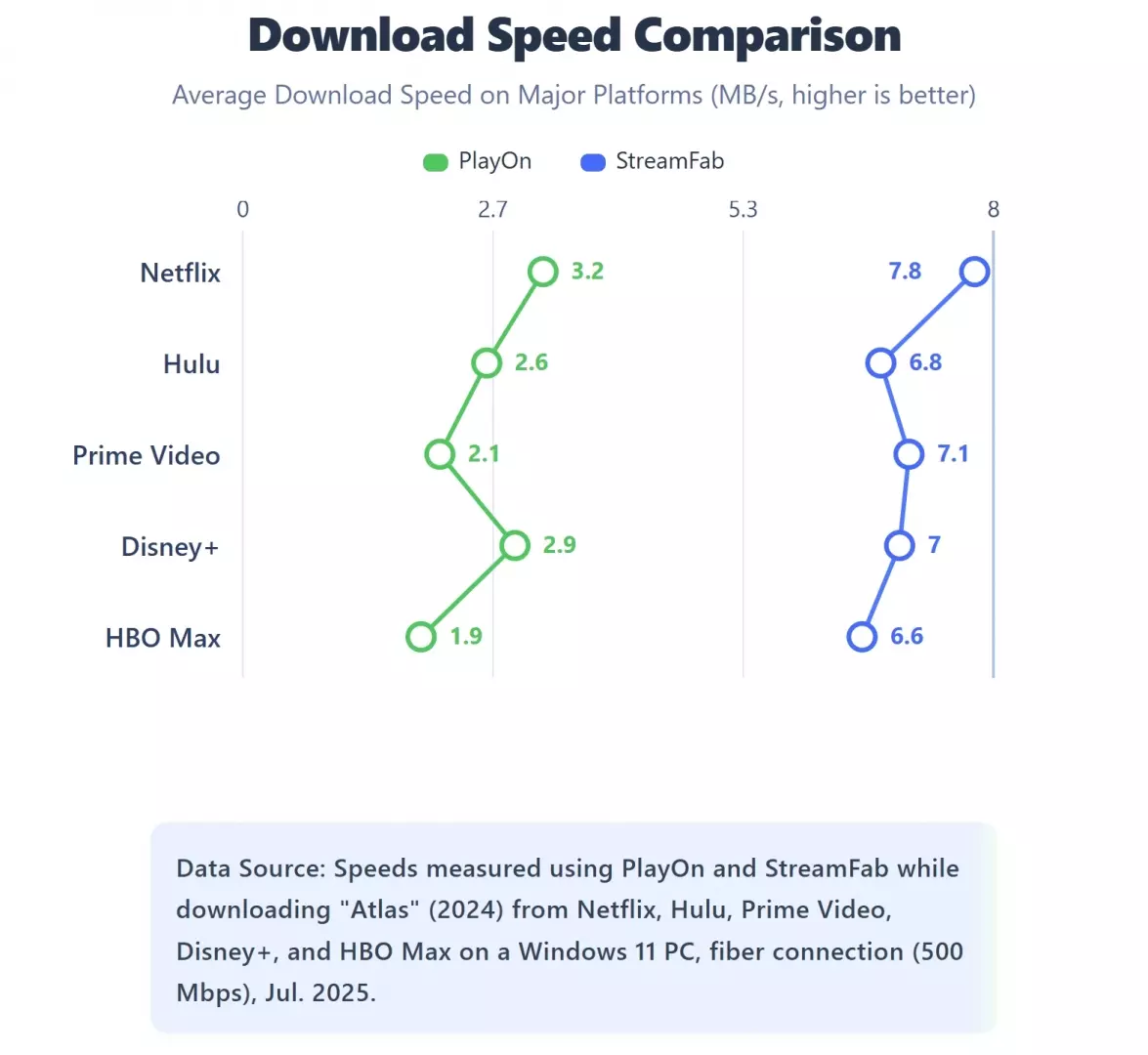

Additionally, I found that PlayOn often has high CPU usage Test method: July 2026 on Windows 11 with a title of roughly two hours, using the selected available quality. The observed StreamFab run finished in about 14 minutes; the PlayOn workflow followed real-time playback. The original test did not preserve an auditable output file size or CPU range, so those figures are not generalized. A single title cannot represent every service, setting, update, or computer.
StreamFab avoids this pitfall completely. Since it downloads the encrypted package and decrypts it locally without needing a visual renderer, your GPU and CPU remain virtually idle, allowing you to multi-task freely.
Files, Devices, and Playback Workflow
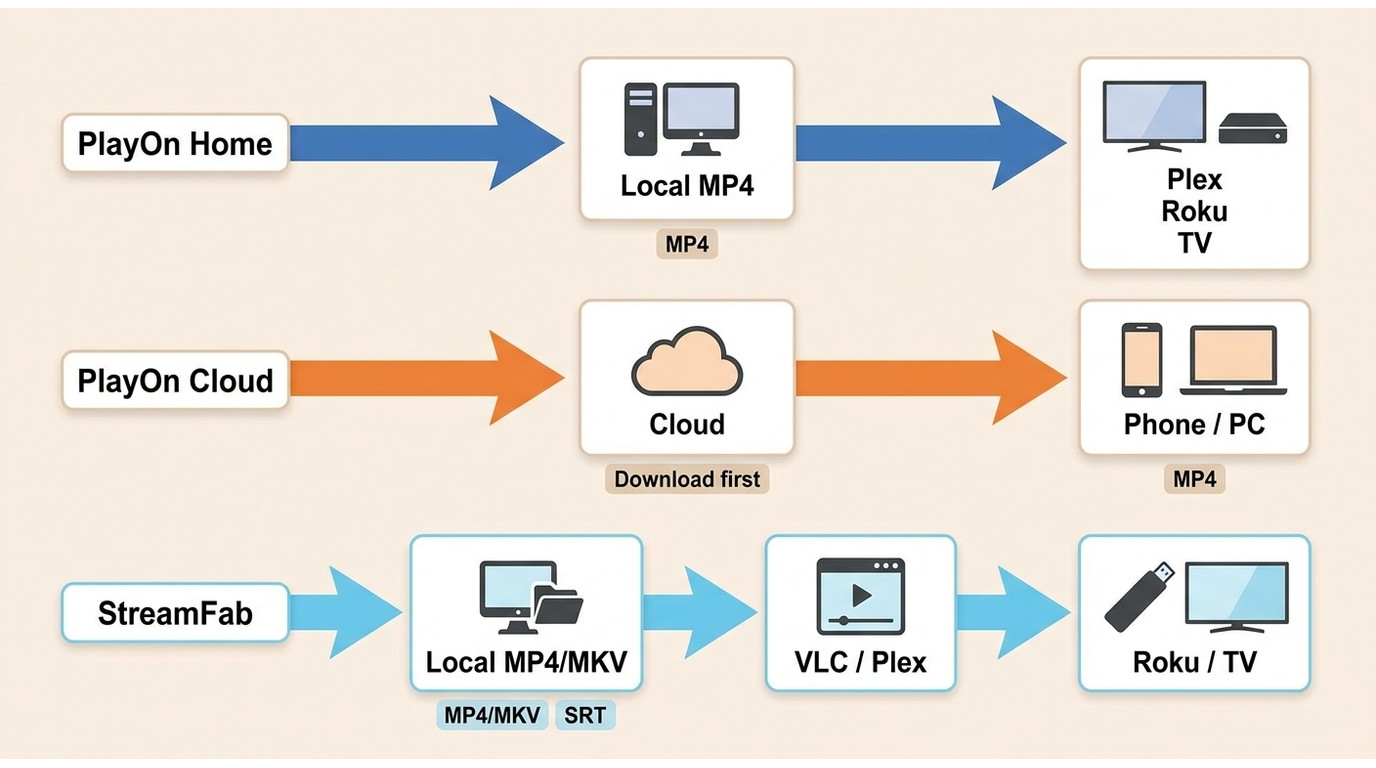
PlayOn Home and StreamFab both support a local-file workflow, while PlayOn Cloud adds a cloud-retention and download step. That difference determines how soon you can transfer a video, how much local space you need, and what happens before playback.
- MP4 versus MKV: MP4 and MKV are containers, not playback guarantees. MP4 is the safer first choice for broad device support, while MKV can hold more track options, but the target device must still support the selected video codec, audio, and subtitles.
- Subtitles: external SRT files are easy to edit and replace, while remuxed or embedded subtitles keep the assets together. Actual availability depends on the service and workflow.
- Audio: Stereo or 5.1 availability depends on the source, selected track, container, and player. A saved file can succeed while a Roku, Plex client, or television still rejects one track.
- Transfer: PlayOn Home recordings and StreamFab outputs can be copied from local storage. PlayOn Cloud recordings must first be downloaded from the account's cloud storage.
For Plex, Roku, VLC, or another target app, test one file with the exact container, video codec, subtitle mode, and audio track you plan to use. Local-library builders will usually prefer StreamFab or PlayOn Home; mobile cloud users may value PlayOn Cloud's remote queue more.
Reliability, Limits, and Service Changes
Use the official StreamFab installer, then sign in to the streaming service inside the app. License activation is separate from the streaming-service login; if activation fails, use official StreamFab support.
Streaming-service changes, title differences, software updates, settings, and hardware can temporarily affect either workflow. For StreamFab compatibility changes, the current download status page provides the relevant update path.
A successful save also does not guarantee compatible playback on every destination. Before paying, use a trial with a representative title and the player or device where you intend to watch it.
From Sign-In to a Playable Local File
Before you start, install the relevant app, keep an active account for the streaming service, choose content you are authorized to access, and confirm that the destination player has enough storage.
- PlayOn Home: Install it on Windows, sign in to the streaming service, select the title, and start the recording. When it finishes, open the configured local recording folder and play the MP4 file.
- PlayOn Cloud: Request the recording in the mobile app and wait for cloud processing to finish. Download the completed MP4 to your phone or computer, then open it from the folder selected during download.
- StreamFab: Install StreamFab All-In-One from the official download page on Windows or macOS, sign in to the chosen service, select the title and available output settings, and save it. Open the selected output folder to find the MP4 or MKV file.
Finally, open one file in the player or device you plan to use and check the selected audio track and subtitles before adding more titles to the queue.
PlayOn vs. StreamFab Pricing and Value
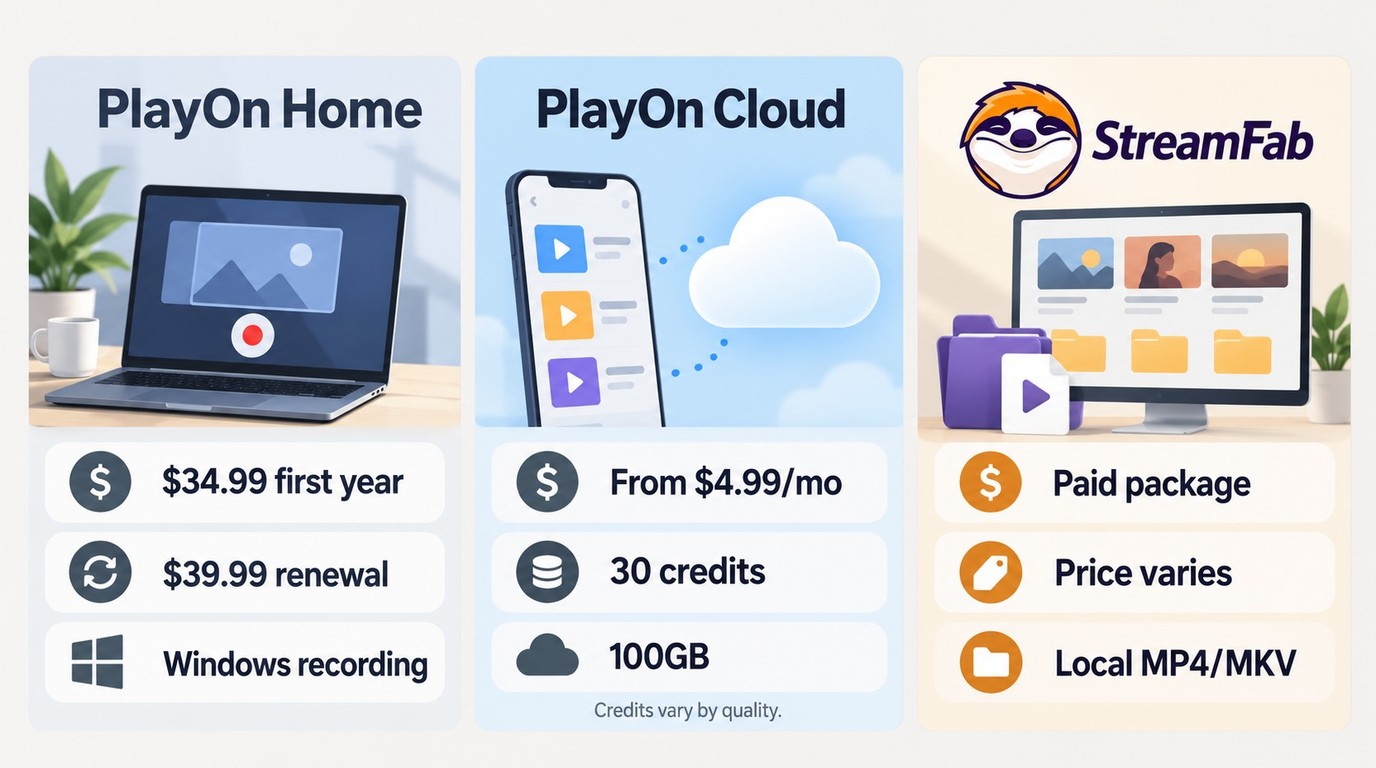
PlayOn cost follows either a Home subscription or a Cloud plan with credits and storage. StreamFab pricing uses paid desktop packages for its local-file workflow.
| Pricing factor | PlayOn Home | PlayOn Cloud | StreamFab All-In-One | Pricing model |
|---|---|---|---|---|
| Annual or quarterly subscription | Subscription with included monthly credits and storage | Paid desktop packages; price varies by package | Current stated cost | $39.99 per year or $14.97 per quarter |
| Plan-dependent; extra packs start at 50 credits for $7.50 and extend to 450 credits for $49.99, with a separate 500-credit option for $65 | No fixed price stated here because available packages and offers vary Included usage | Local real-time recording on one Windows workflow 30 monthly credits with plan storage from 100GB to 4TB | Local use across supported services and modules under the selected license Storage and overflow | Uses local PC storage |
| Plan storage plus seven-day overflow retention | Uses local computer or attached storage | Free or trial access | Free SD, ad-supported mode | Credit-based plan limits |
Prices and plan details are stated as of July 2026. The comparison uses listed plan terms and does not include taxes or temporary promotions.
PlayOn Home costs $34.99 for the first year, $39.99 per annual renewal, or $14.97 per quarter. PlayOn Cloud plans start at $4.99 per month with 30 monthly credits and 100 GB of storage. PlayOn US purchase pages, as of October 2026.
Optional PlayOn Cloud packs currently include 50 credits for $7.50, 250 credits for $35, a promotional 300-credit pack for $34.99, and 500 credits for $65. The credits required for a recording depend on the selected quality, so these pack prices should not be treated as a fixed per-title cost.
StreamFab All-In-One is sold as a paid Windows and macOS desktop package covering supported services and local MP4 or MKV workflows. Its package structure is better suited to readers comparing a multi-service local library than to a credit-based cloud queue.
PlayOn Credits and Storage Costs
As of October 2026, PlayOn US purchase pages list Cloud plans from $4.99 per month with 30 monthly credits and 100GB of storage; higher tiers reach 4TB. Separate anytime-credit packs cover additional recording volume.
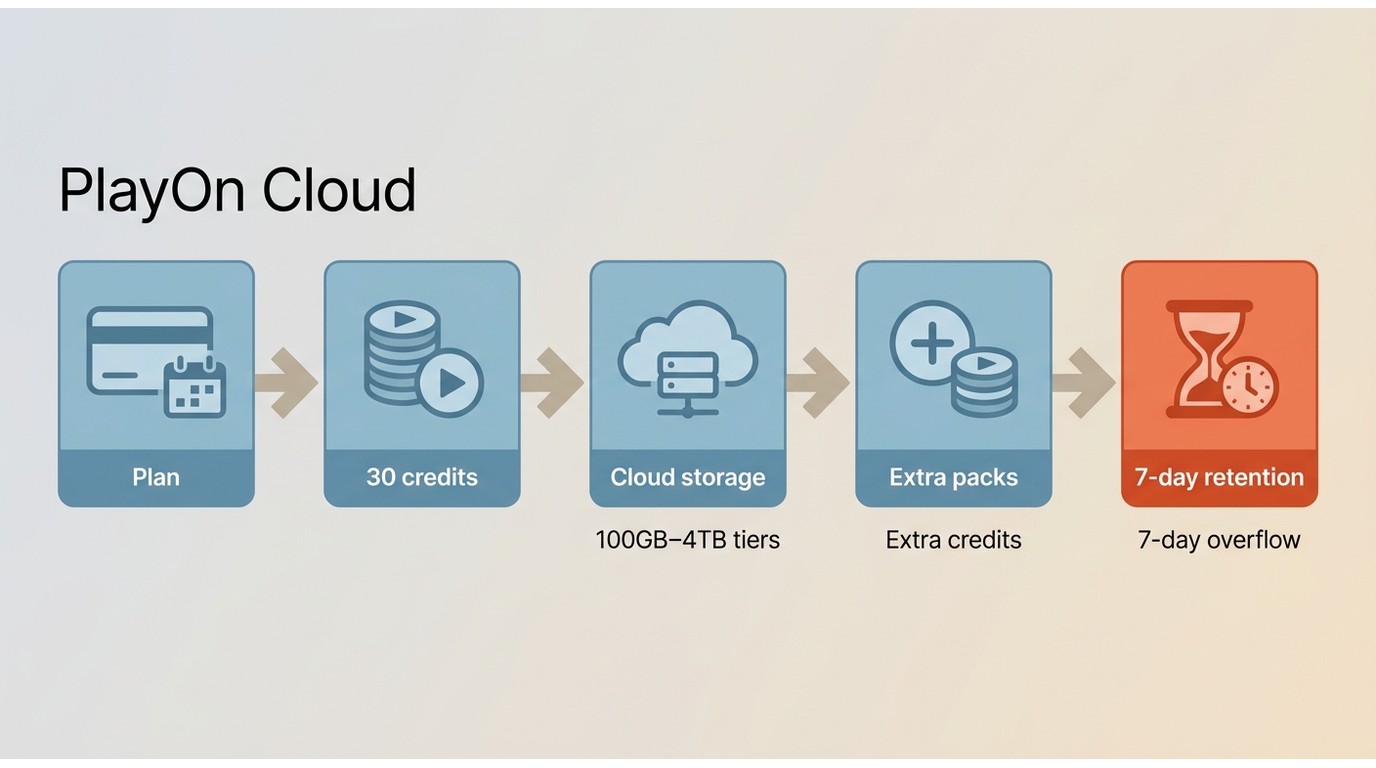
The cost consequence depends on use. A light mobile user may stay within included credits; a high-volume queue can require extra packs and more storage management. Current packs include 50 credits for $7.50, 250 for $35, a promotional 300 for $34.99, and 500 for $65. Because credit use depends on the selected recording quality, check that requirement before calculating a per-title cost. Seven-day overflow retention gives a short window to download recordings that exceed the normal storage allowance.
PlayOn Cloud cost check
- Plans start at $4.99 per month with 30 monthly credits and 100GB of cloud storage.
- Recordings that exceed the plan allowance use seven-day overflow retention before the extra copy leaves the overflow area.
- Optional anytime-credit packs include 50 credits for $7.50, 250 for $35, a promotional 300 for $34.99, and 500 for $65.
StreamFab Cost and Three-Year Value
There is no honest three-year winner without a usage assumption. For a three-year PlayOn Home comparison, one first year at $34.99 and two $39.99 annual renewals total $114.97 before taxes, assuming unchanged rates. PlayOn Cloud varies with the plan, extra credits, storage, and recording volume. StreamFab offers paid desktop packages for supported services, including StreamFab All-In-One and standalone module options.
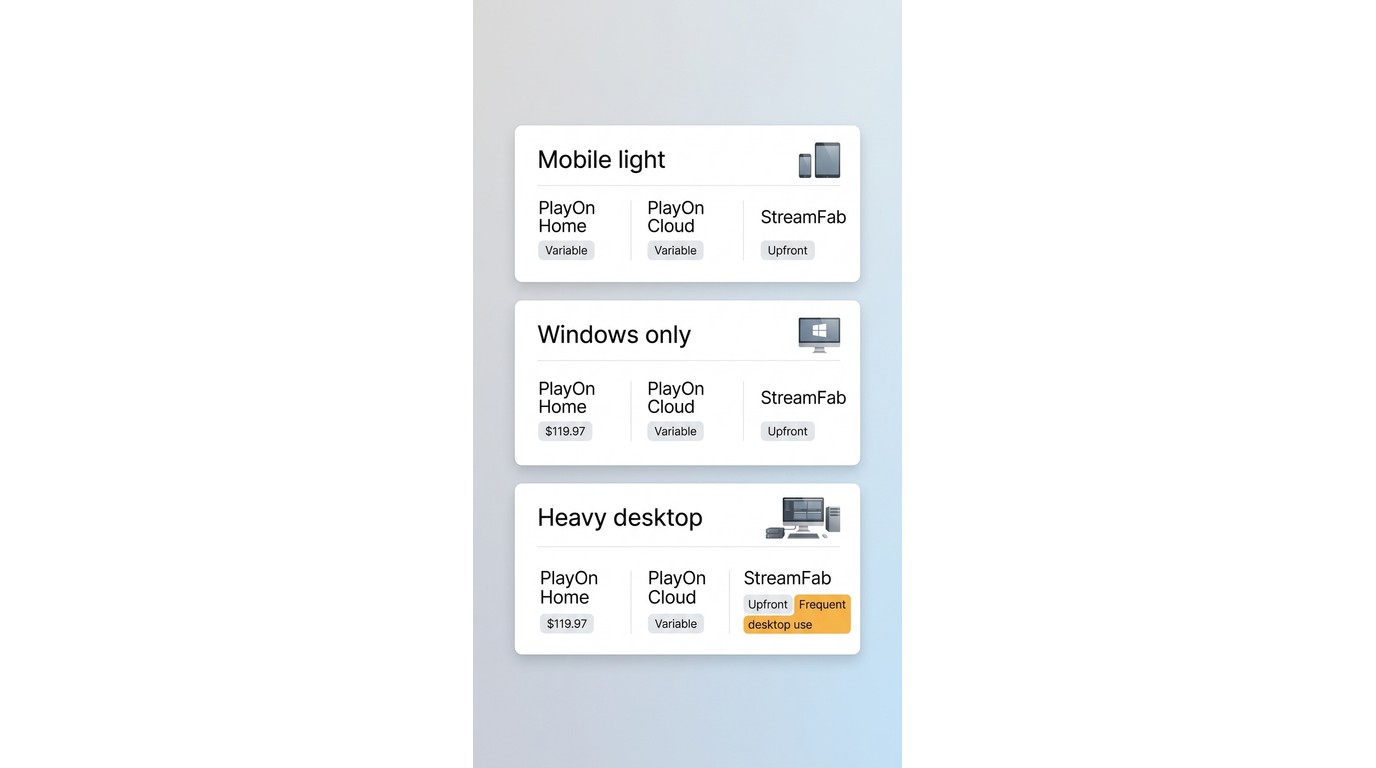
StreamFab All-In-One may fit frequent multi-service Windows or macOS users who want local MP4/MKV files, subtitles, multiple tracks, and batch tasks. PlayOn Home fits a lower annual entry budget and real-time Windows recording, while PlayOn Cloud fits lighter mobile-first use.

StreamFab All-In-One is a Windows and macOS option for supported-service local MP4/MKV workflows, with batch tasks, subtitle choices, and audio-track selection where available.

Use saved content for personal offline viewing only when you are authorized to access it and the platform terms and applicable law permit.
If an all-in-one package covers more services than you need, StreamFab MyCombo offers a module-selection route. My budget rule is to compare the services you actually use, not the largest feature list.
User Ratings and Support Signals
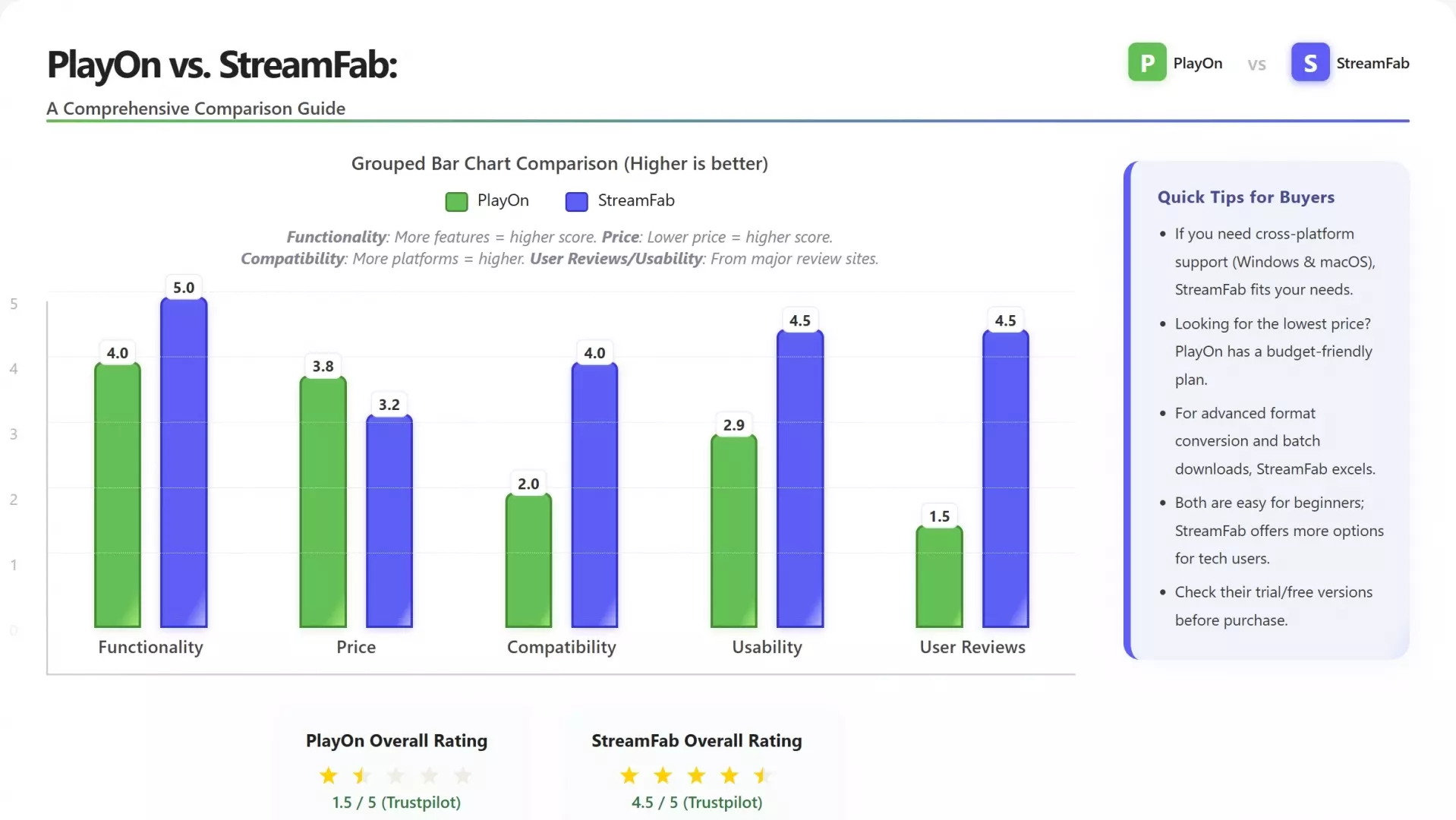
Review scores are signals, not controlled product tests. Dated, product-specific experiences are more useful here because they preserve whether the comment concerns PlayOn Home, PlayOn Cloud, or StreamFab and when it was posted.
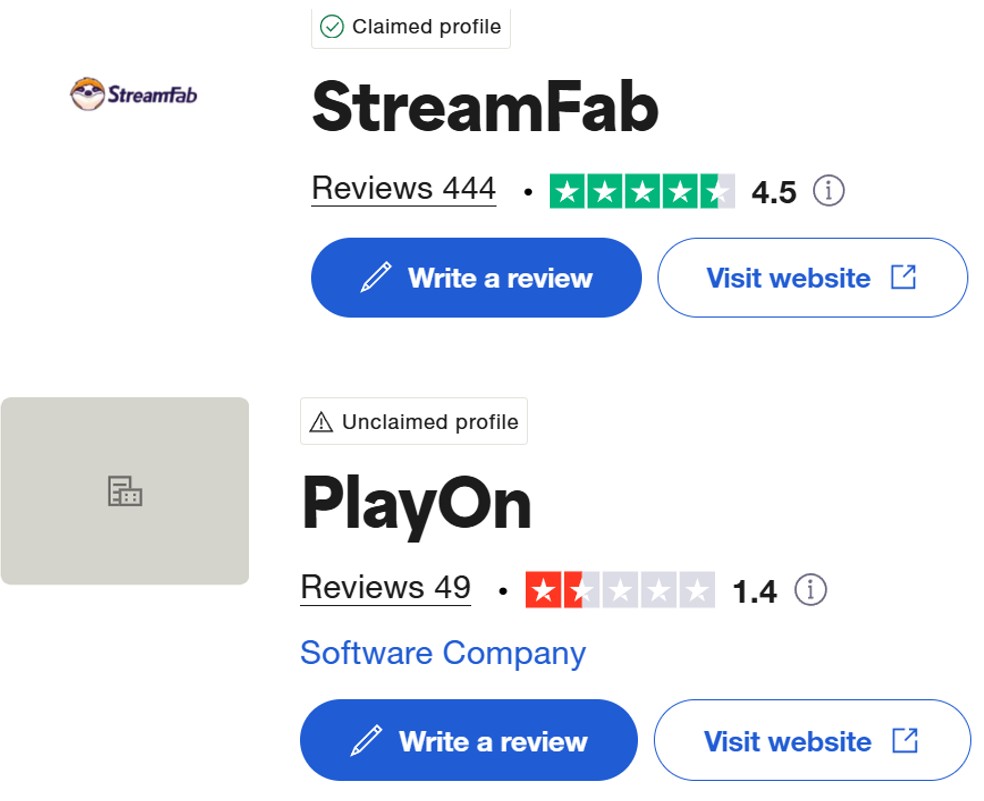
PlayOn Rating and Recurring Complaints
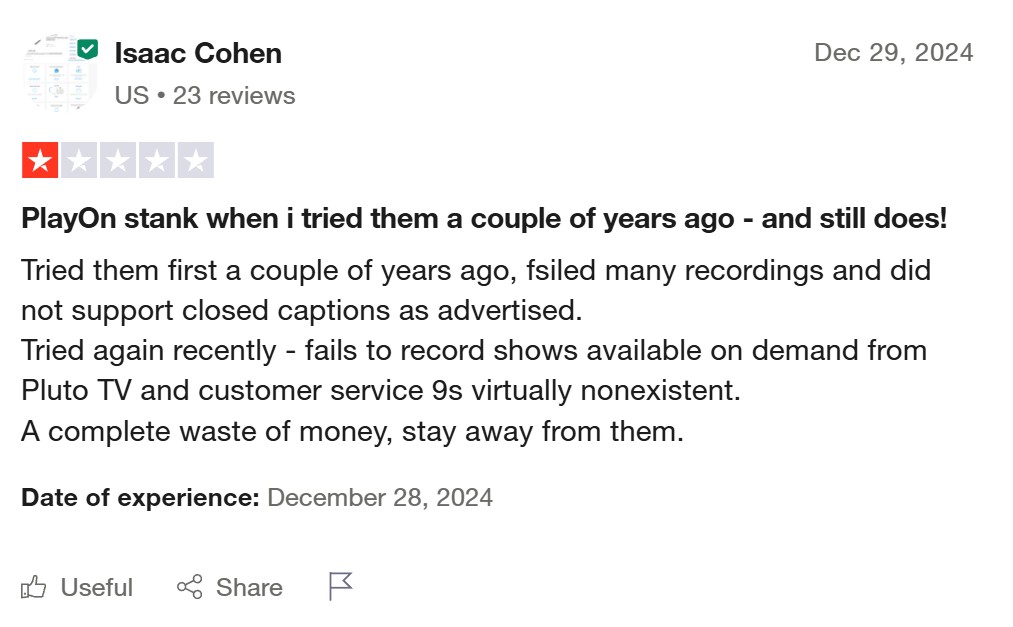
Historical 2025 comments show mixed experiences across PlayOn's current products. One PlayOn Cloud user described Cloud as more stable, while another reported audio synchronization problems after editing Cloud recordings; a PlayOn Home user reported repeated recording failures (Reddit, 2025). These are individual experiences, not a current reliability rate for either product.
StreamFab Rating and Support Feedback
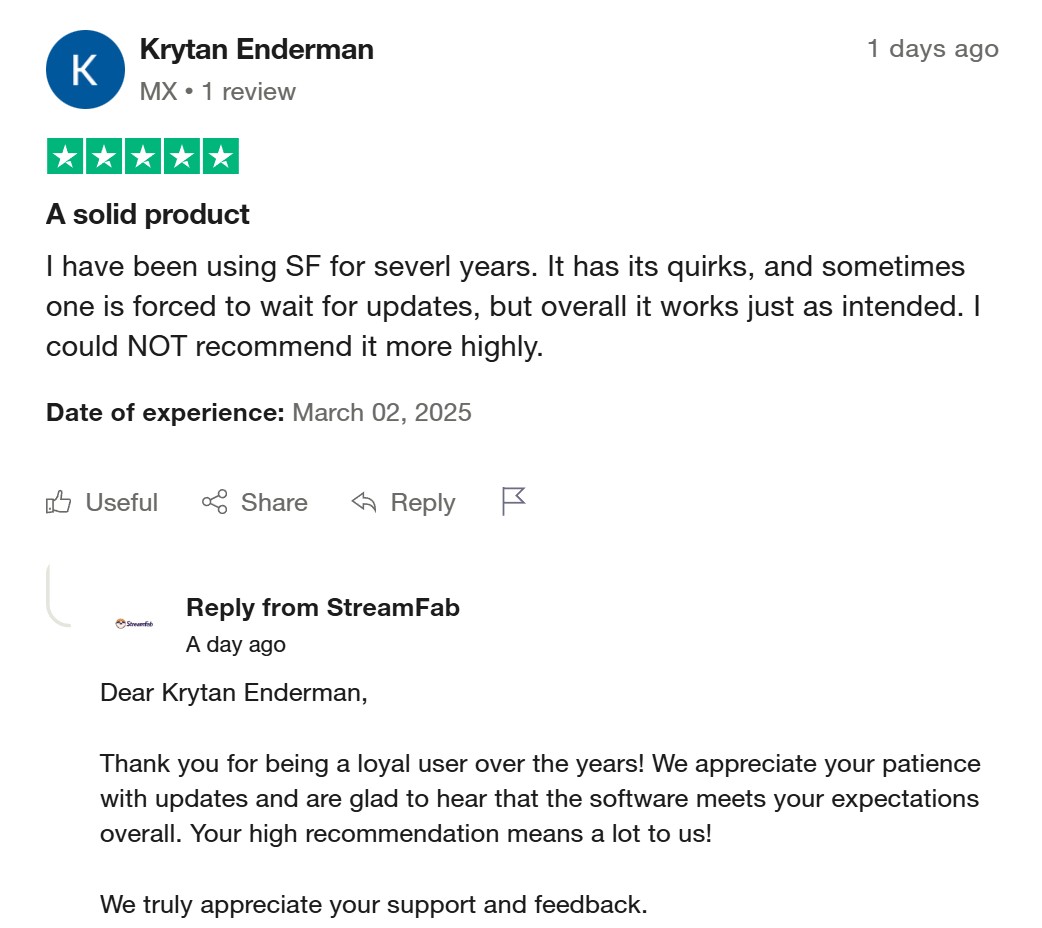
Historical StreamFab comments are also mixed. A customer said support resolved the major issues they reported in 2024 (Reddit, 2024). In 2026, another user described StreamFab as generally effective with some remaining bugs, while a separate comment criticized maintenance when services break (Reddit, 2026). For service changes or unresolved activation and compatibility issues, use StreamFab's official download status page and support.
My synthesis is to prioritize recent reports about your streaming service and intended playback destination over a headline score. The StreamFab forum can also show whether a current issue has an active workaround or update discussion.
Which Tool Fits Your Use Case?
There is no universal winner. The best PlayOn alternative or StreamFab choice starts with where the work happens, then turns on viewing volume and budget, and finally on whether the saved file plays correctly on your target device.
- Choose PlayOn Home if you use Windows, prefer a lower annual entry cost, and accept real-time recording.
- Not ideal for: macOS users or anyone who cannot leave the PC available for the title's runtime.
- Choose PlayOn Cloud if mobile control and remote processing matter more than direct local output.
- Not ideal for: high-volume users who want to avoid credits, storage management, and a later download step.
- Choose StreamFab if you use Windows or macOS and prioritize a desktop local library with MP4/MKV options, subtitles, and multiple tracks where available.
- For lighter needs: a phone-first cloud workflow or the lowest recurring entry cost may point to PlayOn Cloud or Home; StreamFab fits readers who place more value on desktop local-file control.
I'd use PlayOn Home for occasional Windows recording, PlayOn Cloud when remote mobile control matters most, and StreamFab when the destination is a desktop-managed local library.
FAQs
Final Verdict
StreamFab vs PlayOn is a workflow decision, not a championship. PlayOn Home suits lower-entry Windows recording, PlayOn Cloud suits lighter mobile and cloud use, and StreamFab suits Windows or macOS users building a flexible local-file workflow.
If I were choosing a multi-service desktop library, I would favor StreamFab for MP4/MKV choices, track control, and batch tasks where supported. For occasional Windows recordings with a smaller initial commitment, PlayOn Home may fit better; for phone-led remote recording, PlayOn Cloud is the clearer match. Whichever route you choose, check a representative file on the player you actually use.
Use PlayOn or StreamFab only with a valid subscription or other authorized access, for content you are authorized to save for personal offline viewing. Do not share, upload, sell, or distribute saved files, and follow the applicable platform terms and local law.