
The short answer: If you have a valid Prime subscription, you have five realistic ways to keep a personal offline copy on PC. Start with Amazon's official app for in-app viewing (up to 25 titles, 30-day expiry as of June 2026). If that doesn't fit, three desktop tools (StreamFab, MovPilot, RecordFab) and one free recorder (OBS) cover the gaps. Last verified: June 2026.
I've spent the last few weeks re-testing all four tools on a 2024 Windows 11 build and a MacBook Air M2 (macOS Sonoma 14.5) because the landscape shifted noticeably in 2026. The official download option is the right starting point, but its device-lock and expiry enforcement have gotten stricter (the WA5002 expiration error is now a routine community complaint), which is exactly why most readers end up here looking for alternatives.
What Does "Ripping" Amazon Prime Video Actually Mean?
In this guide, "ripping" means creating a personal backup of titles you can already watch under a valid subscription or purchase, so you can view them later when the internet isn't available. It is not a way to redistribute, upload, or share content with anyone else, and it does not replace paying for the service.

- It does not mean uploading or sharing the files with anyone else.
- You still need to follow US copyright law and Amazon's Terms of Use.
- Saving presupposes a valid subscription plus personal, authorised, offline use.
Is It Legal to Save Prime Video for Personal Offline Use?
For personal offline viewing in the US, saving content you're authorised to access generally sits in the same zone as recording a TV show on a DVR: tolerated for private, non-commercial use, but not an explicit safe harbour. Redistribution, in any form, is a hard line you should never cross.
The Bright-Line Rules: What's Allowed and What Isn't
From the legal side, what you do with the file matters more than the act of saving itself:
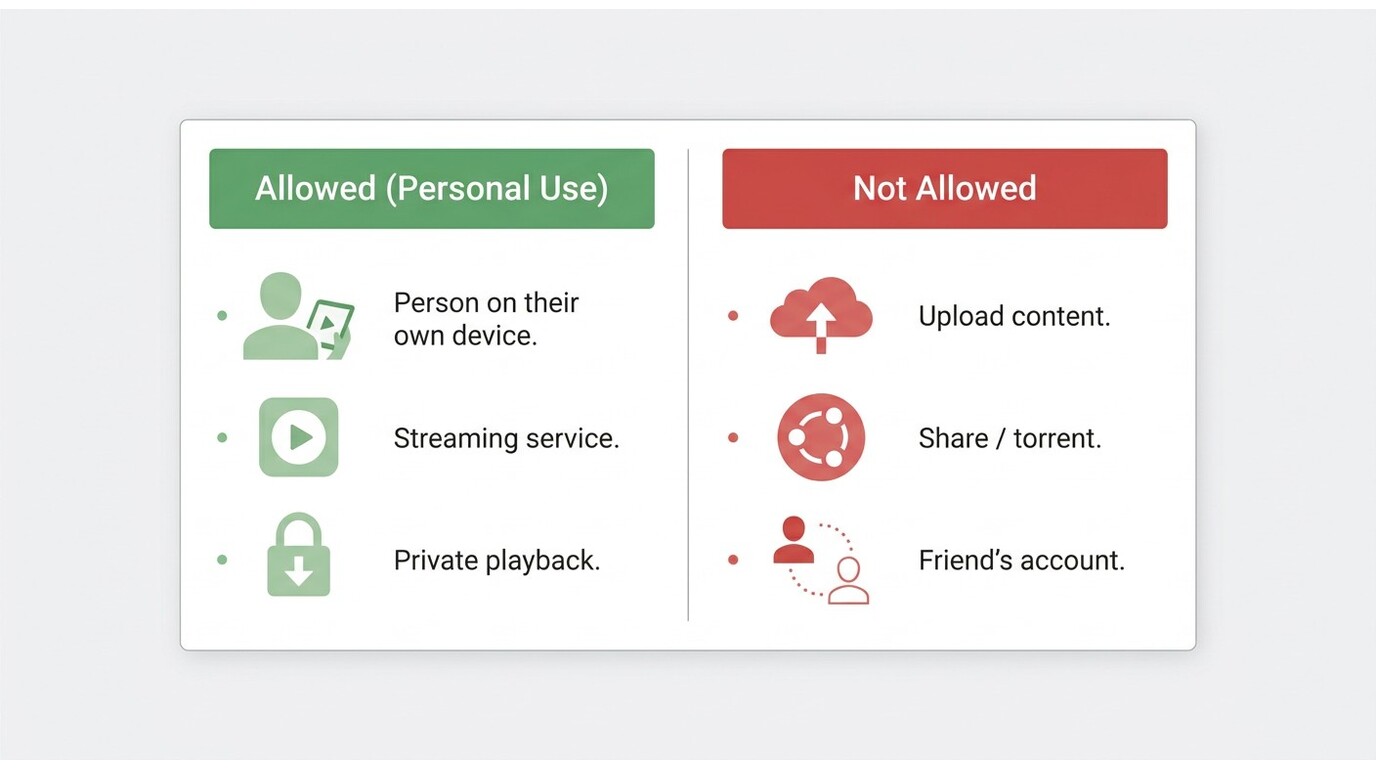
- Allowed (generally tolerated): Saving a title you can already watch under your own subscription for your own private playback on devices you own.
- Not allowed: Uploading, selling, torrenting, or sharing the file. Using a friend's account. Reselling access. Removing watermarks for commercial reuse.
- Verify locally: US copyright law evolves, and platform Terms of Use are updated periodically. When in doubt, check Amazon's current terms or talk to a qualified attorney — this article isn't legal advice.
Safety Checklist: How to Download Without Triggering Flags
Amazon doesn't publish a specific volume threshold, but community reports over the last year point to a few behaviours that have triggered warning emails and, in some cases, account suspensions. Keep your usage pattern indistinguishable from normal consumer behaviour:
- • Keep download sessions to personal-use quantities. Queuing 100+ episodes overnight is the pattern that gets reported most often as a trigger.
- • Avoid aggressive VPN hopping while a download is in flight. Pick a stable connection and stay on it.
- • Log in only with your own legitimate Amazon account, inside the tool's built-in browser. Never share credentials with third parties.
- • Don't run multiple downloaders against the same account at the same time.
- • Download installers only from the official vendor site. Fake "Amazon rippers" are a well-documented malware vector.
None of this is a guarantee, since Amazon's enforcement is opaque and changes over time. But these habits keep you well clear of the patterns that get flagged.
Why Amazon Prime Video Blocks Screen Recording: DRM Explained
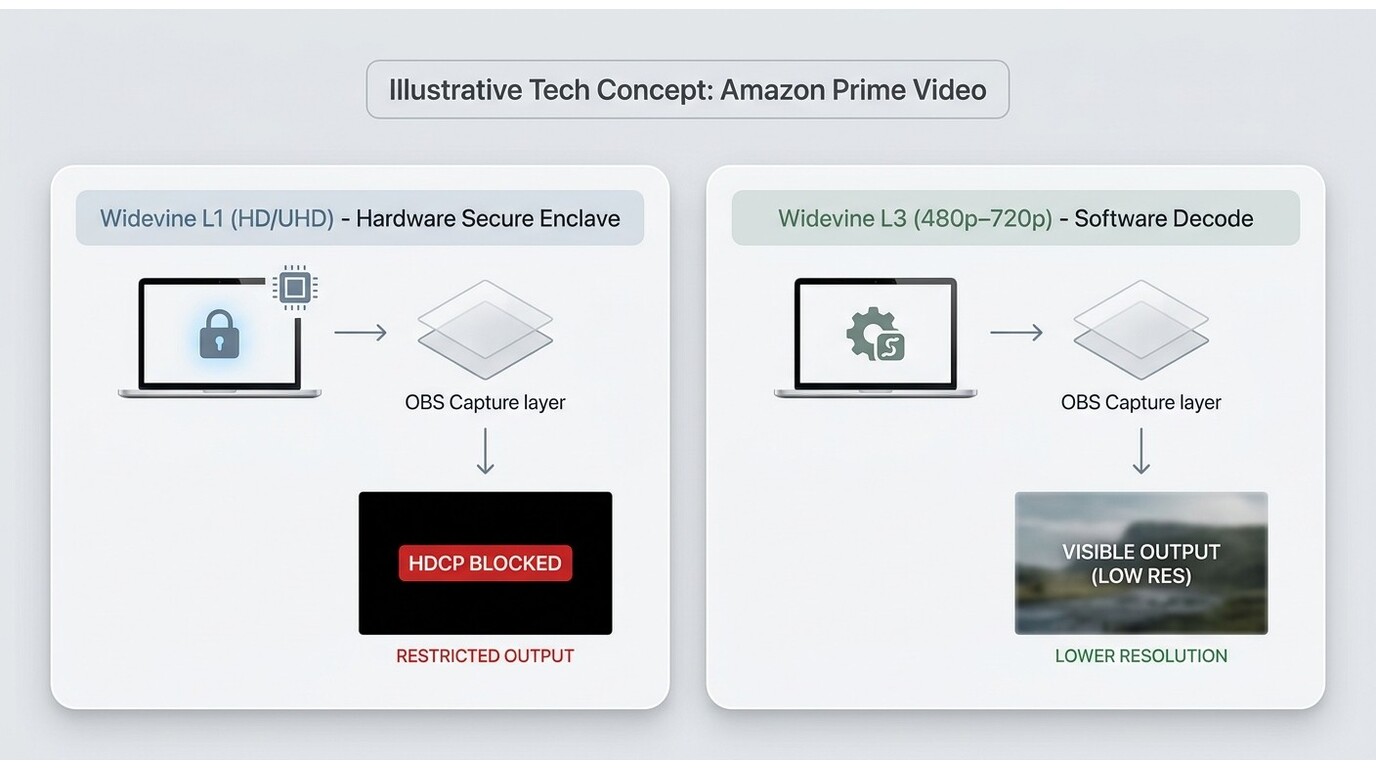
Amazon Prime Video uses Widevine, a content protection layer from Google, to keep the video stream from being captured by ordinary screen recorders. That's the technical reason a screen recording often turns into a black rectangle with working audio, and it's also why official downloads can only be played inside the Prime Video app.
What Widevine Is and Why It Causes a Black Screen
Widevine ships in two main tiers relevant here:
- Widevine L1 — the highest tier, used for HD/UHD streams. Decoding happens inside a hardware secure enclave on the device, and HDCP enforcement blocks the output from being captured by anything sitting on top of the OS rendering pipeline.
- Widevine L3 — software-level decoding, used for lower-resolution streams (typically 480p–720p) on devices without a secure enclave.
When you try to screen record a Prime Video title on a modern browser or app, the player detects the capture attempt and either blacks out the protected region or refuses to render frames into the captured surface. Hardware-accelerated decoding makes this worse, because the decoded frames never reach the part of the GPU memory a generic capture tool can read. Testing OBS Studio 30.2 on a Windows 11 laptop with a Chrome browser, I got a clean black rectangle within about two seconds of playback starting — a textbook L1 + HDCP block.
Why Official Downloads Are Device-Locked and Time-Limited
When you tap "Download" in the official Prime Video app, you're not getting a plain MP4. You're getting an encrypted container that only the Prime Video app can decrypt, on the specific device that downloaded it, for a limited window. The decryption key is leased from Amazon's servers and tied to your subscription status, the device ID, and a timer. That's why downloads expire and can't be transferred — it's enforced at the file level, not by the app's UI.
Understanding this distinction matters because it determines which method is even worth trying for your setup: recorders work around DRM by capturing the rendered frame (where they can), while direct downloaders work with the platform's authorised stream to produce a standard video file.
The Official App First: What Amazon's Built-In Download Can (and Can't) Do
Before installing any third-party tool, check whether the official Prime Video app already covers your needs. It's free, fully compliant, and works on mobile — which the rest of this guide does not address. This guide covers PC (Windows and Mac) workflows only; for Android or iOS, the Prime Video mobile app is the primary supported path.
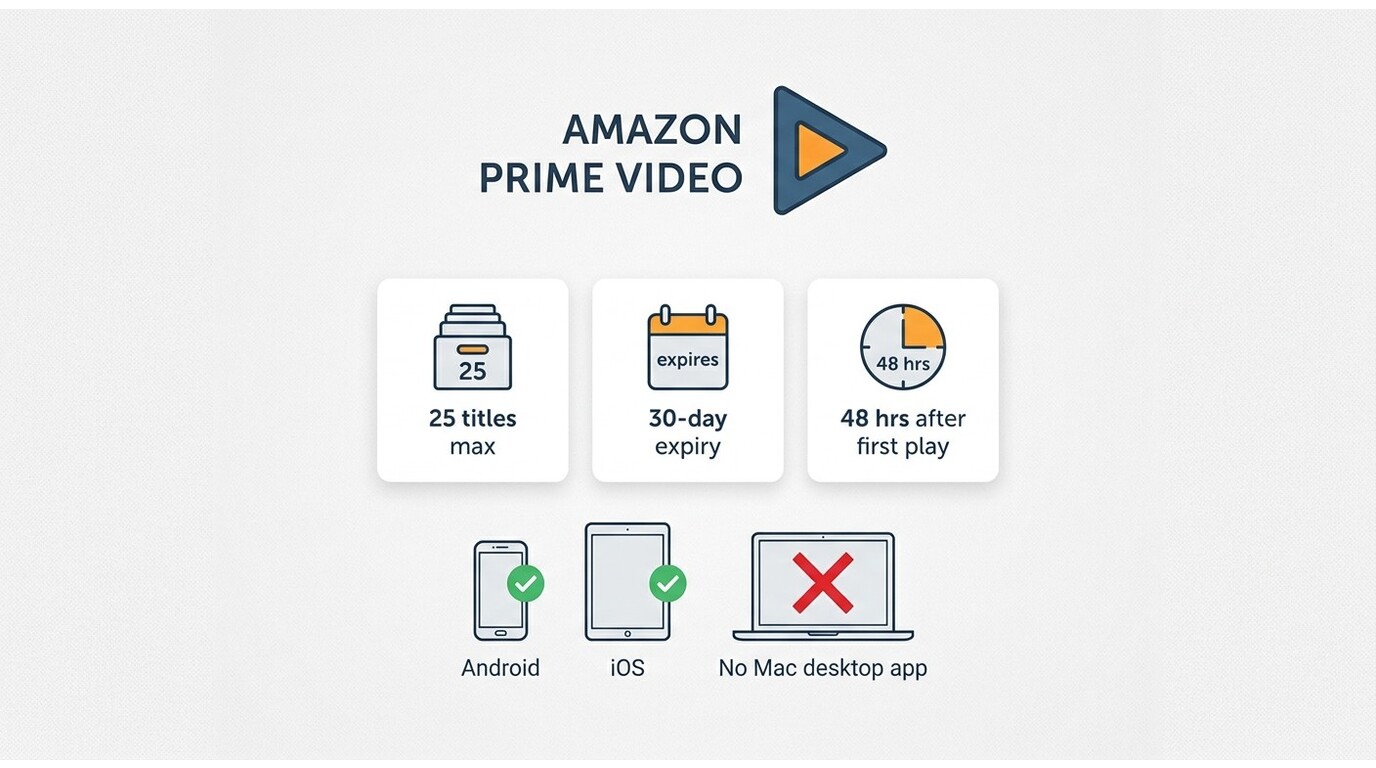
- Up to about 25 downloaded titles per account at a time.
- Downloads expire 30 days after you download them, or 48 hours after you first press play.
- Files are encrypted, device-locked to the Prime Video app, and cannot be transferred to another device or player.
- Available on Android, iOS, Fire tablets, Fire TV, and the Windows 11 Prime Video app. Not available in standard web browsers on Mac.
- Mac users have no first-party download path at all — there is no Prime Video desktop app for macOS.
- The 48-hour playback window starts the moment you press play, even if you only watch five minutes.
- Community threads consistently surface the WA5002 expiration error and "download succeeded but playback fails offline" bugs, which become more frustrating on long flights or in rural areas with no signal.
- No subtitle export, no audio-track export, no transfer to a VLC-friendly format.
If the official download covers what you need, start there — it is the safest and simplest path. If you're on Mac, travelling for longer than 30 days, or already burnt by the WA5002 error twice this month, the next four methods are where this article earns its keep.
4 Ways to Save Prime Video Offline on PC (Within Your Valid Access)
Here's the four-method shortlist at a glance. Click a name to jump to my detailed test notes.
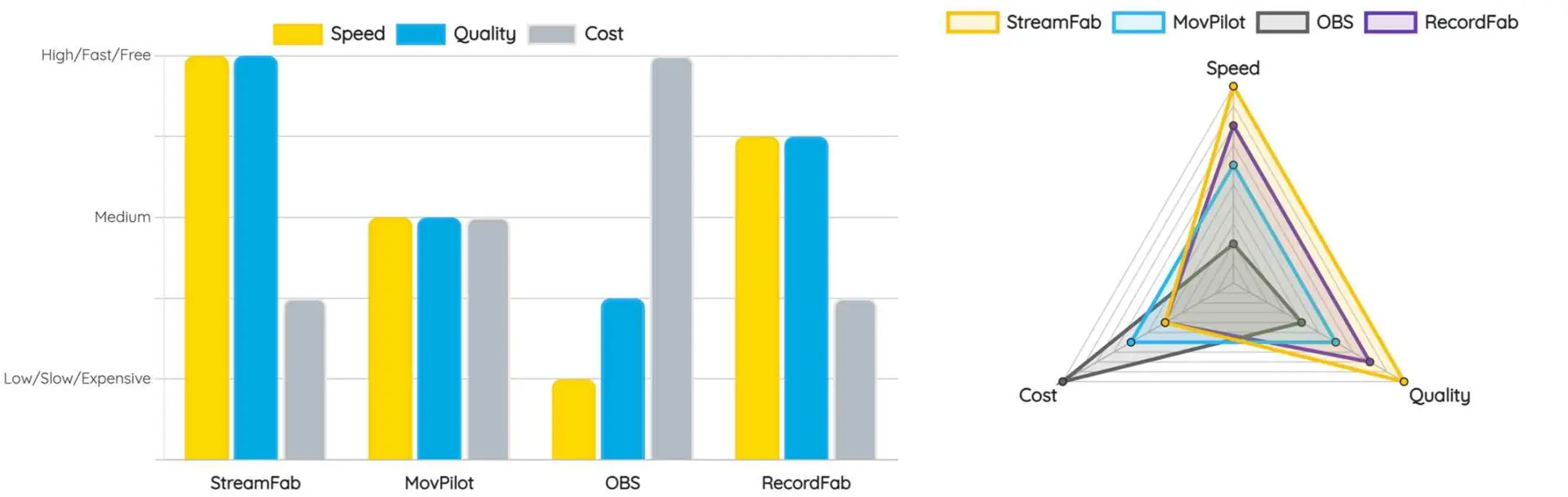
| Best for | Speed | Quality | Cost | |
|---|---|---|---|---|
| StreamFab Amazon Downloader | Long-term users with lots of titles | Very fast (direct download) | Up to 1080p with EAC3 5.1 | Paid, free trial with no payment info required |
| MovPilot Amazon Video Downloader | Short-term users with a few movies | Medium (re-encoding) | ~960p output (re-encoded) | Cheaper, limited free trial |
| OBS Studio | Free users who don't mind real-time recording | Real-time (1× video length) | Depends on settings and hardware | Completely free |
| RecordFab | Users who want a guided recorder without OBS fiddling | Faster than OBS (2× option) | Up to 1080p recording | Paid, with limited trial |
Method 1: StreamFab Amazon Downloader — Fastest, Highest Quality

What stood out in testing: the free trial does not ask for payment information and does not require you to create a StreamFab account. That matters if your primary concern is the word "safe" in your search — there's no surprise-charge trap to navigate before you can see whether the tool works for your setup.
StreamFab Amazon Downloader works by pulling the authorised video file directly from Amazon's servers, rather than re-encoding or screen-capturing. The output is a standard MP4 or MKV file in up to 1080p with EAC3 5.1 audio, plus your choice of audio tracks and subtitle tracks as separate selectable files. On a 2024 Windows 11 laptop with a 100 Mbps connection, a 45-minute episode finished in about 3 minutes — roughly 15× real time, which matches the "very fast" label in the comparison table.

A direct-download desktop tool for saving Amazon Prime Video titles as MP4 or MKV files for personal offline viewing on devices you own.
- Free trial requires no payment information and no StreamFab account — useful for evaluating safety risk first
- Available on Windows and macOS, which closes the Mac gap left by the official app
- Saves Prime Video titles as MP4 or MKV files in up to 1080p with EAC3 5.1 audio
- Supports H.264 or H.265 codec selection, multiple audio tracks, and external subtitle export
- Handles normal, purchased, and rented titles (rental terms vary by region — verify locally)
- Auto-download option for newly released episodes from a watchlist

- The 30-day trial caps you at 3 Amazon downloads — enough to evaluate, not enough to commit
- A paid licence is required for ongoing use and full feature access
- Platform DRM updates occasionally require a software patch on StreamFab's side, which can mean a one- or two-day lag during major Amazon changes

- One honest caveat: I noticed an uptick in Amazon Prime Video warning emails in community threads earlier this year, and most of the cases I read through traced back to either aggressive VPN behaviour or extremely high-volume queuing – not the tool itself. The same safety checklist from the legal section above applies here. If you keep StreamFab to moderate, personal-use downloads on your own account, it stays well clear of the patterns that get flagged.
For full setup instructions, I've written a detailed walkthrough on how to download Amazon Prime Video to PC. The short version below is what I ran in my latest test.
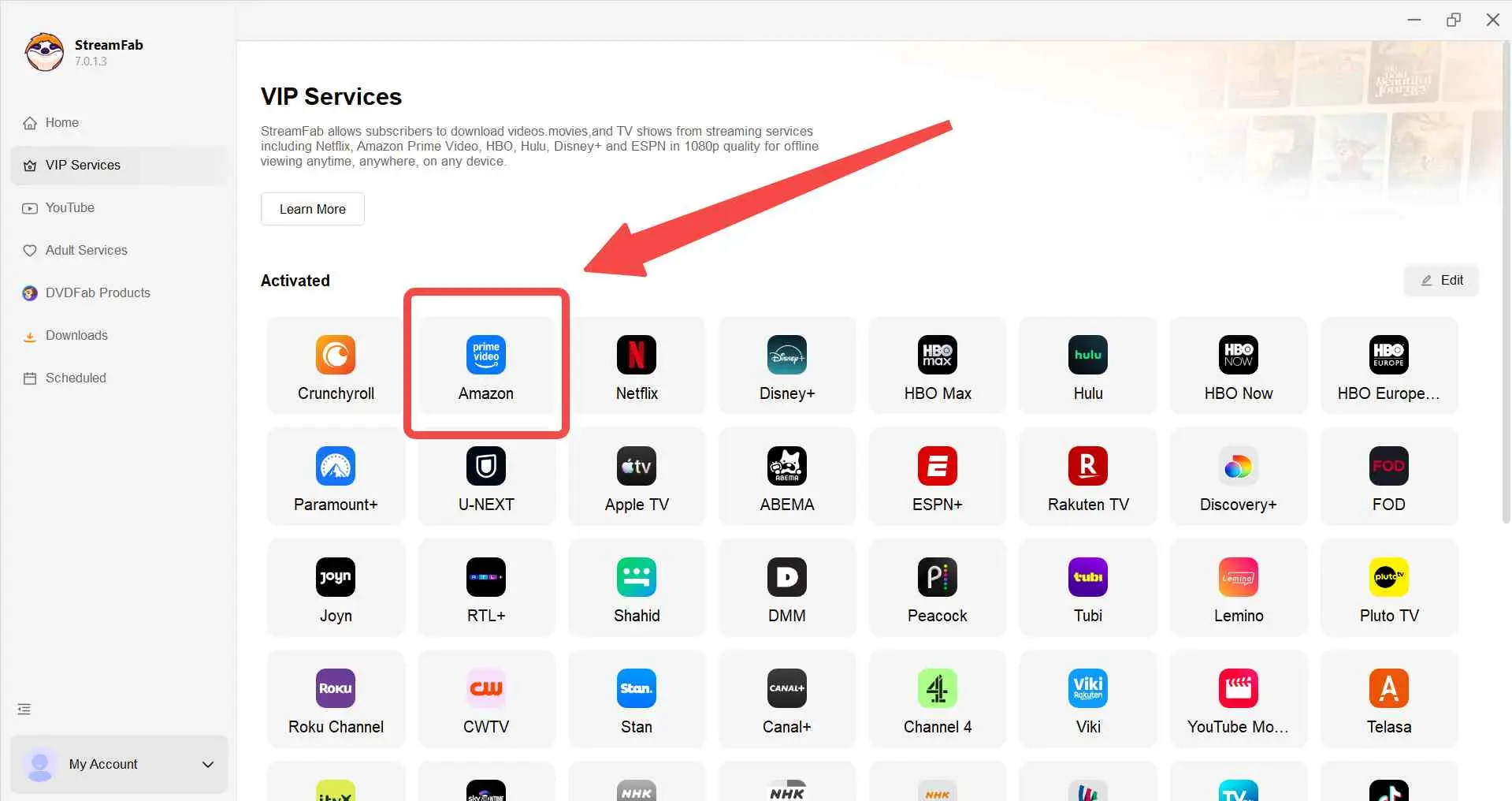
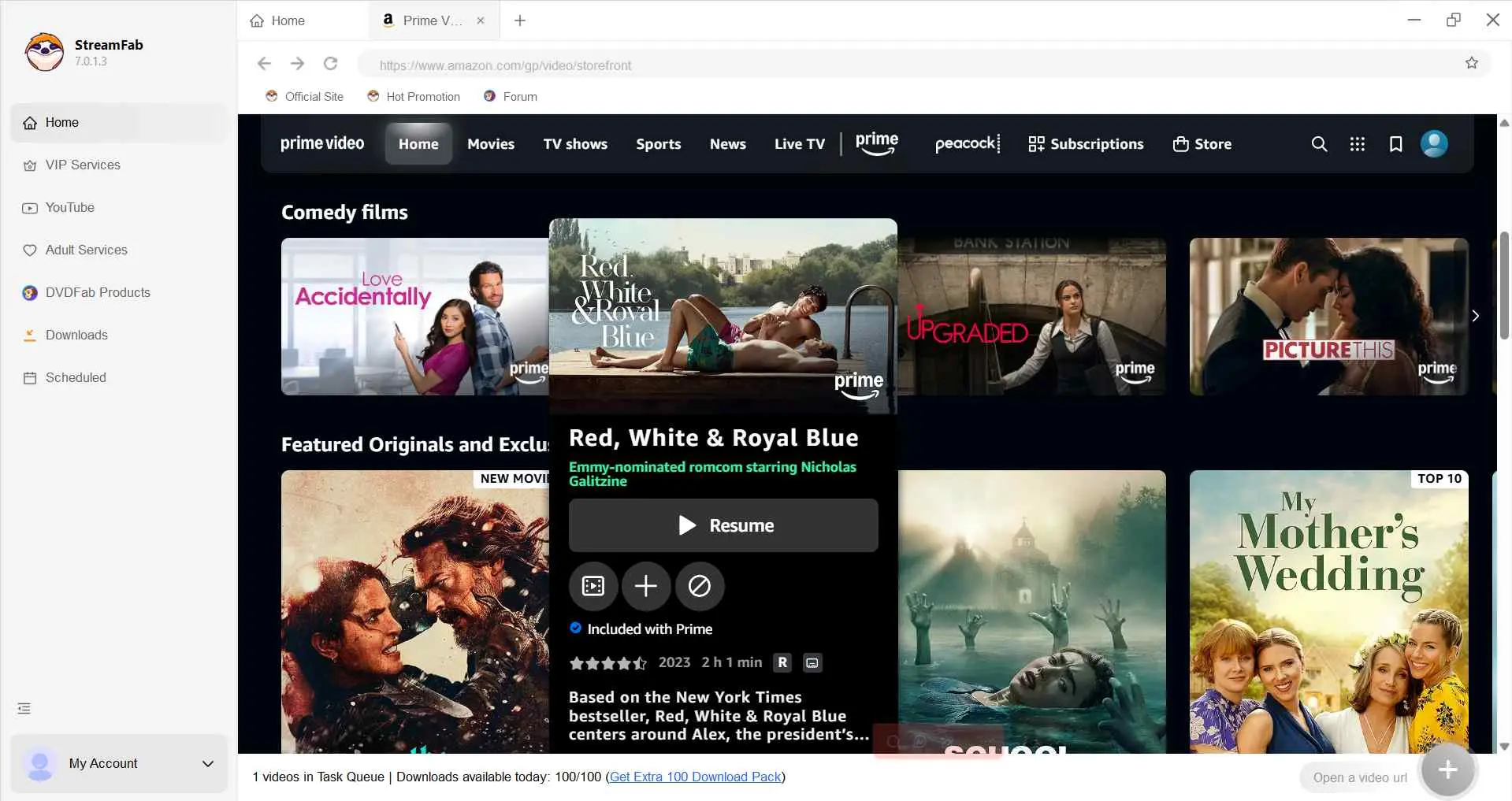
Sign in with your own Amazon account in the built-in browser, then browse to the catalog you're already authorized to watch.
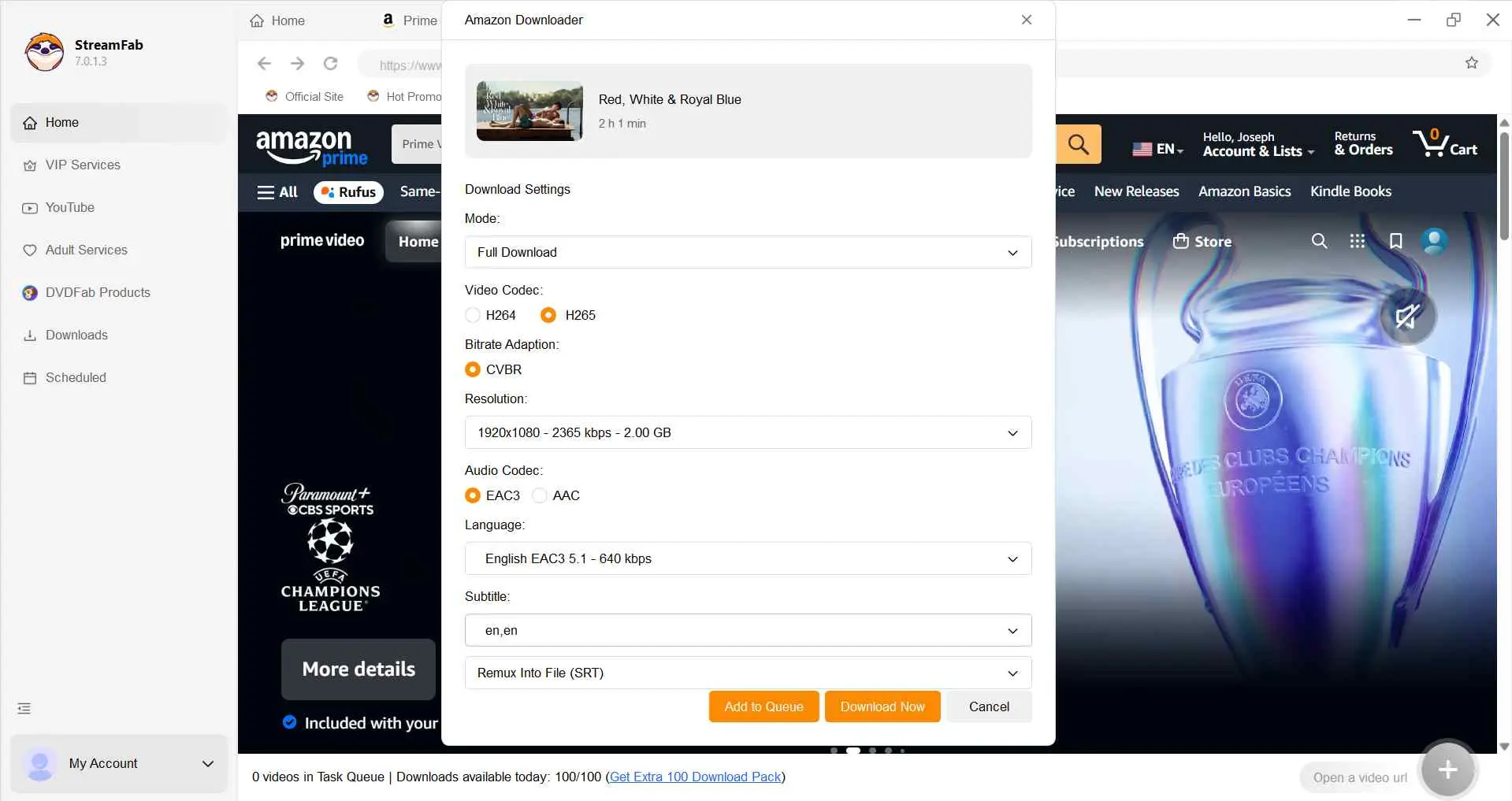
Open the title you want to save. When the options panel appears, pick your video quality, audio tracks, and subtitles.
You can set a download schedule in the left corner to enable the auto-download function for new episodes.
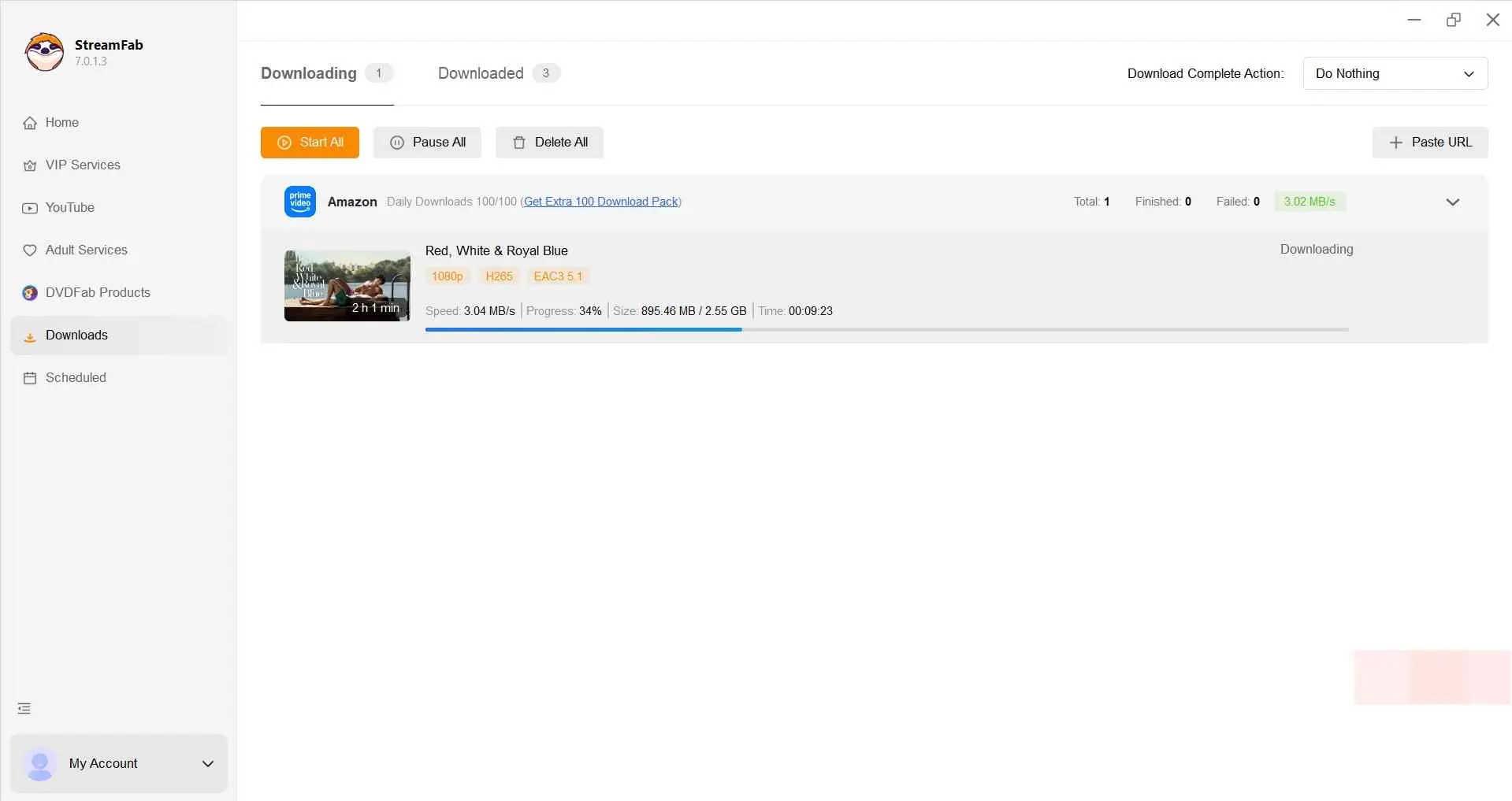
Start the task and let it run. Keep it to moderate, personal-use volume — don't try to download a full series overnight.
Method 2: MovPilot Amazon Video Downloader — Lighter and Cheaper
- • Best for: occasional users who want to save a few specific titles before a flight.
- • Not ideal for: anyone building a long-term offline library where quality matters.
If you only need a handful of movies before a trip, MovPilot is a lighter, cheaper option. It does the same job as StreamFab on paper, but the engine is different: MovPilot re-encodes the stream rather than pulling the source file. That's the source of both its lower price and its lower output quality.
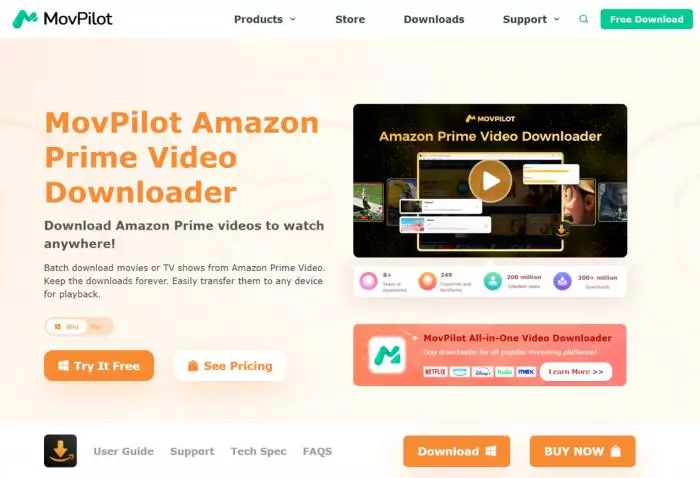
The advertised resolution is 1080p, but in practice the output measures closer to 960p with visible re-encode artefacts on high-motion scenes. For a closer look, here's a full MovPilot Amazon Downloader review.
- Available on Windows and macOS
- Saves Prime Video titles to MP4 or MKV for personal offline viewing within your valid access
- Supports subtitle, audio track, and metadata download
- Compatible with rented and purchased Amazon movies (region-dependent)
- Built-in title search
- Free trial limits each download to the first 6 minutes
- Occasional stalls mid-download, requiring a task restart
- Real-world output closer to 960p than the advertised 1080p
- No scheduled download mode
- No background download — the app needs to stay in the foreground
- Re-encoding produces measurable quality loss and slower processing than a direct downloader
Install the app from MovPilot's official site and open it.
Sign in with your Amazon account, then search for the title you want to save (within your valid access).
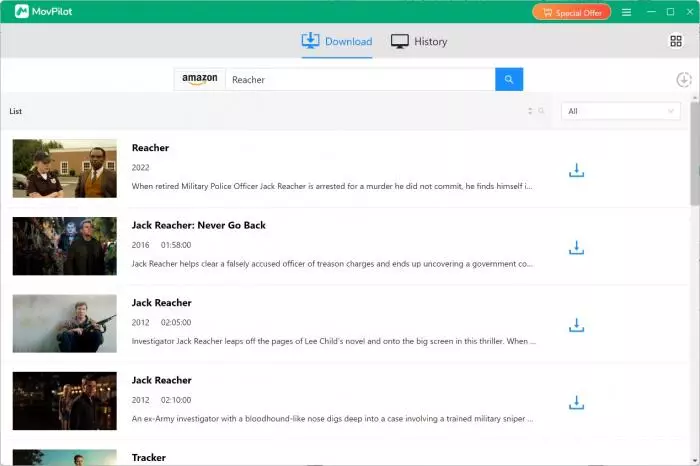
Pick your preferred output settings (quality, audio, subtitles) when the options panel appears.
Start the task and watch progress in the app's task list until it finishes.
Method 3: OBS Studio — Free but Limited by DRM
- • Best for: anyone who refuses to pay and is willing to accept that half the catalog will give them a black screen.
- • Not ideal for: building a serious offline library.
If you'd rather not pay, OBS Studio is where most readers land. I've had OBS on my main laptop for years — it's great for streaming, recording calls, and general screen capture. It will technically screen record Amazon Prime Video, but the Widevine + HDCP combo described in the DRM section above usually leaves you with a black rectangle and working audio.
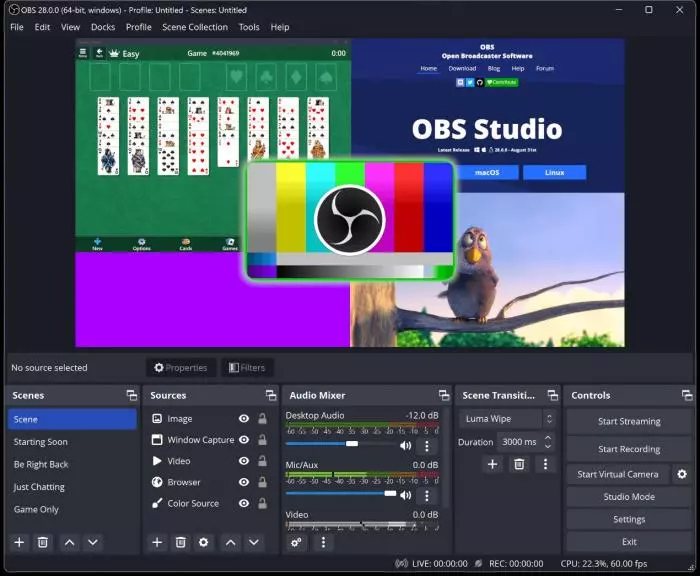
Prime Video uses Widevine and HDCP to keep the rendered frame out of any generic capture surface, so OBS sees the player window but not the protected video region inside it.
If you're determined to use a recorder rather than a direct downloader, this is the workflow that gives OBS the best chance:
- Use Firefox, not Chrome or Edge — Firefox's media stack falls back to a path OBS can sometimes capture.
- In Firefox: open
about:configand setmedia.hardware-video-decoding.enabledto false to disable hardware acceleration. - In OBS, use Window Capture mode targeting the Firefox window — not Display Capture.
- Test with a short 30-second recording before committing to a full episode.
- If the screen still goes black, the title is on Widevine L1 enforcement and you'll need RecordFab (purpose-built recorder) or StreamFab (direct download, no capture step) instead.
For recording-style workflows, results vary noticeably by title, device, and region — treat this as a best-effort fallback, not something you can count on every time.
- Completely free and open-source
- Available on Windows, macOS, and Linux
- Highly flexible: tweak bitrate, resolution, audio sources, overlays
- Frequently blocked by Widevine DRM on Prime Video (black screen)
- Setup requires extra steps for any chance of working with Prime
- Steep learning curve compared with purpose-built tools
- Recording runs at 1× real time — a 45-minute episode takes 45 minutes
- Background sounds or notifications can leak into the recording
- You can't use the PC for other tasks during a recording session
Method 4: RecordFab — Guided Recorder That Solves the Black Screen
- • Best for: users who tried OBS, got a black screen, and want a recorder that just works.
- • Not ideal for: anyone who values lossless output over recording convenience — a direct downloader is the better fit there.
RecordFab is essentially a more guided recorder built for services like Amazon Prime Video, Netflix, and Disney+. Where OBS asks you to configure scenes, sources, and codec settings before you can press record, RecordFab steps through it for you. On a flight prep last month, I needed three episodes ripped quickly and didn't want to babysit OBS — RecordFab handled them in under 30 minutes thanks to its 5× speed option.
Results, as with any recorder, still vary by title, device, and region. But the success rate on Prime titles in my test was notably higher than OBS.
- Handles the Widevine black-screen issue natively on most Prime Video titles
- 5× speed option cuts a 45-minute episode to roughly 22 minutes
- Much simpler setup — no diving through OBS settings panels
- Still slower than direct downloaders like StreamFab
- One task at a time, no batch recording
- Paid software with a limited trial
Install RecordFab from the official site and open the Prime Video service page inside the built-in browser.
Play the title you want to record for personal offline viewing, then pick your recording settings when prompted.
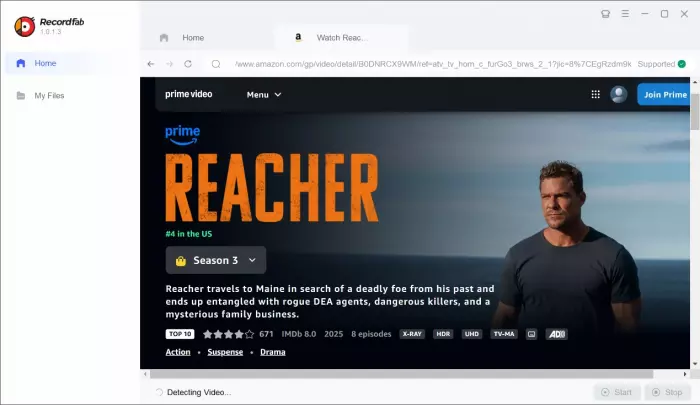
Start the recording and let it finish. Keep sessions personal-use and reasonable — avoid back-to-back marathon recording.
Direct Download vs. Screen Recording: Why the Method Matters for Quality
The four methods above use three fundamentally different engines, and the engine determines the ceiling on output quality. This is the single most useful distinction to understand before you pick a tool.
- Direct download (StreamFab):
The tool requests the authorised encoded video file from Amazon's servers, the same one your Prime Video app would stream. The output is effectively lossless relative to the source. That's why StreamFab's output measures the full 1080p with EAC3 5.1 — it isn't re-rendering anything.
- Re-encoding (MovPilot):
The tool decodes the stream and re-encodes it to a new MP4 or MKV. Every re-encode introduces compression artefacts, which is why MovPilot's real-world output measures closer to 960p with visible loss on motion-heavy scenes. The trade-off is a simpler engine and a lower price.
- Screen recording (OBS, RecordFab):
The tool captures the rendered display frame by frame, in real time. It inherits whatever the player rendered — including any DRM downgrades to lower resolution — and is bound by the actual playback speed (unless the recorder has a 2× option). It's also the only path that fights DRM at the OS rendering layer, which is why it's hit-or-miss.
For most readers who want a clean offline copy that plays on any device, a direct downloader is worth the cost difference over a re-encoder or screen recorder. The exceptions are: zero budget (OBS), or you specifically want a recorder workflow (RecordFab).
Side-by-Side Comparison of All Four Methods (Plus the Official App)
| Method / Tool | Official Prime Video app | StreamFab Amazon Downloader | MovPilot Amazon Downloader | OBS Studio | RecordFab |
|---|---|---|---|---|---|
| Best for | In-app offline viewing on supported devices | Long-term users wanting a portable MP4/MKV library | Occasional users on a tight budget | Free, occasional use | Recorder workflow without OBS setup tax |
| Speed | Direct download | Very fast (~10–15× real time) | Medium (re-encoding) | Real-time (1×) | Up to 5× real time |
| Max quality | Up to 1080p (varies) | Up to 1080p with EAC3 5.1 | ~960p (re-encoded from 1080p) | Depends on hardware/settings | Up to 1080p recording |
| Output format | Encrypted, app-only | MP4 / MKV | MP4 / MKV | Configurable (MP4, MKV, FLV) | MP4 |
| DRM black screen handled? | N/A (no capture) | Yes (direct download avoids capture) | Yes (re-encode path) | No — Widevine blocks most Prime titles | Yes (purpose-built recorder) |
| Playable outside app? | No | Yes | Yes | Yes | Yes |
| Platform | Android, iOS, Fire, Windows 11 app | Windows, macOS | Windows, macOS | Windows, macOS, Linux | Windows, macOS |
| Cost | Free with Prime (~25 titles, 30-day expiry, 48h playback as of June 2026) | Paid; trial requires no payment info | Cheaper; 6-min trial cap | Free, open-source | Paid; limited trial |
Quick takeaways:
- If the 25-title, 30-day window covers you, stick with the official Prime Video app.
- If you want the fastest, highest-quality option, StreamFab is the practical pick for Windows and Mac users.
- If you only need a few titles and want to spend less, MovPilot is lighter and cheaper, with some quality loss.
- If your budget is zero, OBS does the job, but only with the Firefox workaround and only on some titles.
- If you want a guided recorder, RecordFab is the easier path versus OBS.
Frequently Asked Questions
In the US, saving content you already have authorized access to, for private non-commercial viewing on devices you own, is generally treated similarly to DVR time-shifting. Redistribution (uploading, sharing, selling) is a clear copyright violation. Laws vary by jurisdiction and platform Terms of Use evolve, so check Amazon's current terms and US copyright guidance if you're unsure. This is a gray area, not an explicit safe harbor, and not legal advice.
As of June 2026, the Prime Video app allows roughly 25 downloaded titles per account. Downloads expire 30 days after you download them, or 48 hours after you first press play — whichever comes first. Files are encrypted, device-locked to the app, and cannot be transferred to another player. Verify the current limits on Amazon's Help Center, as Amazon adjusts these periodically.
Official in-app downloads stop playing once your subscription lapses or the 30-day window closes — the Prime Video app enforces this at the DRM layer, not just the UI. Local files saved by a third-party tool while you were authorized to access the content remain as standard video files; their continued playback is governed by Amazon's Terms of Use and US copyright law, which you should review before relying on any specific behavior.
Amazon does not publish a specific threshold. Community reports consistently point to two behaviors as triggers for warning emails or suspensions: queuing very high volumes (100+ episodes overnight) and aggressive VPN hopping during downloads. Stay in moderate, personal-use territory, log in with your own legitimate account, and don't run multiple downloaders against the same account simultaneously.
The black screen is caused by Widevine DRM combined with hardware-accelerated decoding, which keeps the rendered frame out of any generic capture surface. For OBS, the best chance is Firefox with hardware acceleration disabled (set media.hardware-video-decoding.enabled to false in about:config) plus Window Capture mode. For a more reliable result, use a purpose-built recorder like RecordFab, or skip capture entirely with a direct downloader like StreamFab.
Almost anything with a modern video player: laptops, phones, tablets, smart TVs, and media-server boxes. VLC, Windows Media Player, Apple's built-in players, and most smart TV file browsers handle MP4 and MKV natively. You can also transfer downloaded movies from Amazon Prime to other devices for private offline viewing.
Rental titles carry stricter licensing terms. Availability and what's permitted vary by region, by specific title, and by Amazon's rental policy at the time. For a deeper look, see this guide on downloading rented movies on Amazon, and always verify against Amazon's current rental terms and US copyright law before saving a rented title.
Update Log
- June 2026: Added official Prime Video app section with current download limits (25 titles, 30-day expiry, 48-hour playback window). Added DRM explainer covering Widevine and HDCP. Consolidated black-screen fix into a single self-contained section. Added two new FAQ entries (official limits, subscription expiry). Updated all year references to 2026.
- March 2026: Updated StreamFab and RecordFab test results on Windows 11 and macOS Sonoma. Refreshed comparison table.
Conclusion
For most US readers in June 2026, the decision tree is short. If 25 titles and a 30-day window cover your needs, the official Prime Video app is the simplest path — start there. If you're on Mac, traveling longer than the official window, or have hit the WA5002 expiration error one time too many, a desktop tool fills the gap: StreamFab for the cleanest output, MovPilot for a cheaper alternative, RecordFab for a guided recorder, OBS for free with caveats.
Whichever route you pick, treat the saved files as a personal offline library for your own authorized access — not as a way to share, redistribute, or replace a subscription. If you want to test StreamFab first, the free trial doesn't require payment information or a StreamFab account, which makes the safety question easy to answer for yourself before you commit.
