
When StreamFab cannot download a title, the failure is usually tied to session state, title availability, service status, or local routing rather than one universal setting. The useful first move is to identify which stage stopped, then run one controlled test before changing several variables at once.
This guide follows that order for a StreamFab download failed message, a queue stuck at zero, an engine notice, or a file that will not play. If analysis itself never detects the video, use the separate analysis-stage guidance; the steps here begin after a title has been recognized.


Quick Summary
If StreamFab cannot download, start with the title and account, not with a blanket VPN change. Confirm playback in a regular browser, check StreamFab status and update notices, refresh both sign-ins, and then test cache and local settings in a controlled order.
- Title gate Play the same title in a normal browser, then try a second title on the same service.
- Session gate Refresh the streaming-service login and StreamFab account, then clear cache and Temp data if needed.
- Local gate Check storage, routing, permissions, queue behavior, and one lower quality or alternate codec only after the earlier gates.
The broader StreamFab Not Working guide covers other failure types, while this page stays focused on download-stage diagnosis.
Identify Download Symptoms
Matching the visible symptom to its stage keeps a StreamFab download failed event from turning into a random settings hunt. I treat the first reproducible symptom as the control: it tells us whether the problem is connection, transfer, output, or service-side.
Download Stuck at 0%
A task that appears in the queue but never leaves 0% has not established a usable transfer. Check title playback, service status, and sign-in before testing VPN, proxy, or firewall routing.

Download Stops or Errors
When progress begins and then stops, the interruption usually occurs during transfer or file writing. Storage, network drops, an expired session, or a numeric code narrows the next test.
Download Engine Popup
A “Video Download Engine does not work correctly” notice can reflect a platform pipeline change seen by multiple builds, not a fault in your Wi-Fi. Follow the status and compatible-build checks in When the Problem Is on StreamFab's Side before repeating local resets.

File Downloads but Will Not Play
A completed file that shows a black screen, missing audio, or a codec error points to output assembly or player compatibility, not necessarily a failed transfer. Test the file in another player before downloading the title again.
- Confirm the selected audio track and subtitle option.
- Compare the same title in MP4 and MKV.
- Retry one codec at a time, such as H.264 and H.265, so the output variable stays visible.
My practical rule is simple: if the transfer reaches completion but playback fails, treat it as an output or remux issue first, not as proof that the source title was unavailable.
Common Causes by Failure Type
StreamFab not working can describe several layers. Use the scope of the failure to choose the next test, then change one variable and retry the same title.
Network, VPN, and Firewall Interference
Routing rules, proxy interception, and endpoint firewalls can stop the initial connection or interrupt it later. Test these after title playback, service status, and sign-in so a local network change does not hide a service-side issue.
Storage, Permissions, and Network Drops
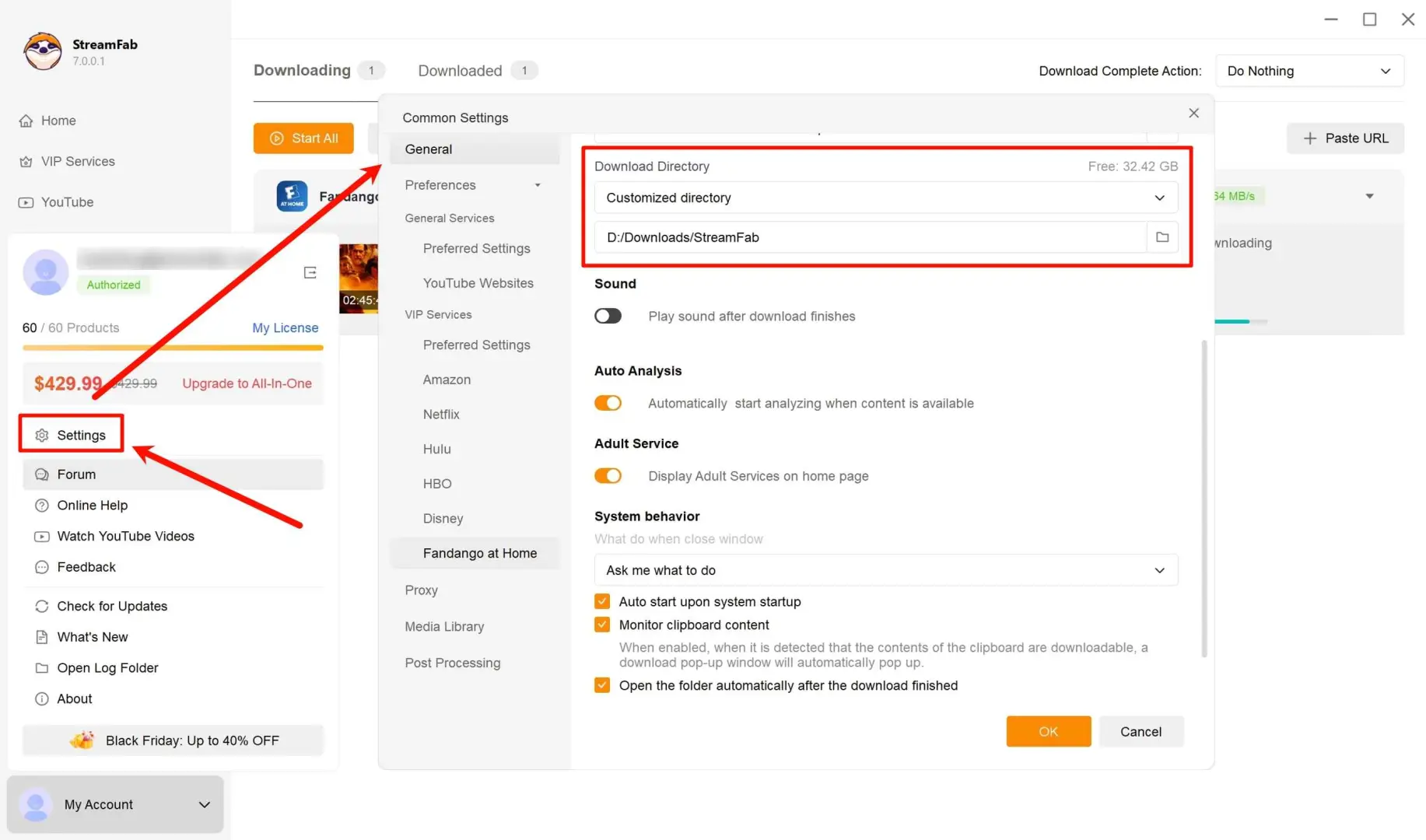
Mid-transfer failures often come from a full target drive, a protected folder, or a connection that drops during the write. Use a user-owned folder with working space beyond the expected output and keep the destination on a writable local or secondary drive.
In a batch run of three LDR S4 episodes on Windows 10 Pro with an i5-9400F, 16 GB RAM, and StreamFab 7.0.1.7, all three episodes completed and the file sizes increased with episode length. That is why I check the destination and write path before blaming the title itself.
All Downloads, One Service, or One Quality Tier
Failure scope is a strong diagnostic signal. If all services fail, inspect the network and application state. If one service or one title fails, check that service session and title availability. If only one quality tier fails, treat resolution or codec access as platform-specific.
Check Title Access and Service Status
Before you clear anything, verify that the same title plays in a regular browser and that another title works on the same service. These two checks separate title-level availability from a service-wide or local failure.
I use this gate because it prevents a perfectly healthy installation from being “fixed” for a title that the account cannot currently play.
Reset Cache and Sign-In State

When playback works but the transfer still fails, clear StreamFab cache and Temp data, then refresh both account sessions. Completed files live in the download folder, so verify that folder before removing temporary data.
Cache cleanup clears temporary browser and session data; it does not target completed downloads in the folder you confirmed. If the same title still fails, keep the new session and move to the error-code or local checks instead of clearing it repeatedly.
Match Error Codes to Next Tests
Use the code as a routing label, not as a diagnosis by itself. The six rows below keep download triage compact; the full StreamFab error code reference has broader code coverage.
| Error code | Likely stage | First check | Next action |
| 210 | Title or metadata handoff | Play the title in a browser | Try a second title, then refresh the service session |
| 310 | Connection during protected-stream setup | Disable VPN or proxy and retry once | Update the build if the code returns |
| 314 | Account authentication | Sign out and back in to StreamFab | Re-enter credentials and run one title test |
| 702 | Final file packaging | Check output codec and writable space | Delete the failed task, switch codec, and retry |
| 909 | Service or engine processing | Check the current status and build notice | Follow the compatible-build guidance and retry once |
| 10201 | Analysis-to-download handoff | Reopen the title after a fresh sign-in | Capture the code and submit reproducible logs if it repeats |
For an exact code explanation, follow the reference linked above; this page keeps each row tied to the next download test.
Step-by-Step Download Fixes

Once title access, status, cache, and error-code gates are clear, work through these local fixes in order. Run one download at a time while diagnosing, then restore your normal queue after the control succeeds.
Check Disk Space
Confirm the destination drive has enough working space for the output and temporary processing files. Avoid relying on a single exact multiplier because output size varies by title and quality.
Reserve extra working space beyond the expected final file size before starting a download, because remuxing can need temporary room as the file is assembled.
Disable VPN, Proxy, and Firewalls
Test routing only after the earlier gates. A VPN, proxy, or security filter can change the connection path StreamFab uses for the transfer.
Some VPN clients leave routing rules active after disconnecting. If the route still looks wrong, close the client and restart the computer before testing again.
Change the Download Path
Protected folders can reject writes without a useful on-screen error. Choose a normal user folder or a dedicated folder on a non-system drive.
- Avoid (Windows): C:\Windows, C:\Program Files, Desktop under a managed account
- Avoid (Mac): /System, /Library, read-only formatted external drives
- Recommended (Windows): D:\StreamFabDownloads or any folder on a non-system drive
- Recommended (Mac): ~/Movies/StreamFab or ~/Downloads/StreamFab
Tune Concurrent Downloads
Queue behavior depends on the build and service. Current releases can run cross-service tasks in parallel while same-service tasks remain ordered, so one task is the right diagnostic control rather than a fixed universal limit.
Current releases support cross-service parallel tasks while same-service tasks stay ordered. Use one task to isolate a failure, then scale the queue to match your build and connection.
Daily quotas and Scheduled Download auto-resume can look like a stalled queue. The download-limit policy explains that separate condition.
Update StreamFab
As of September 2, 2026, treat StreamFab latest version as a compatibility check, not a promise that one patch will restore every title. Use the current notice and the last compatible build shown for the affected service.
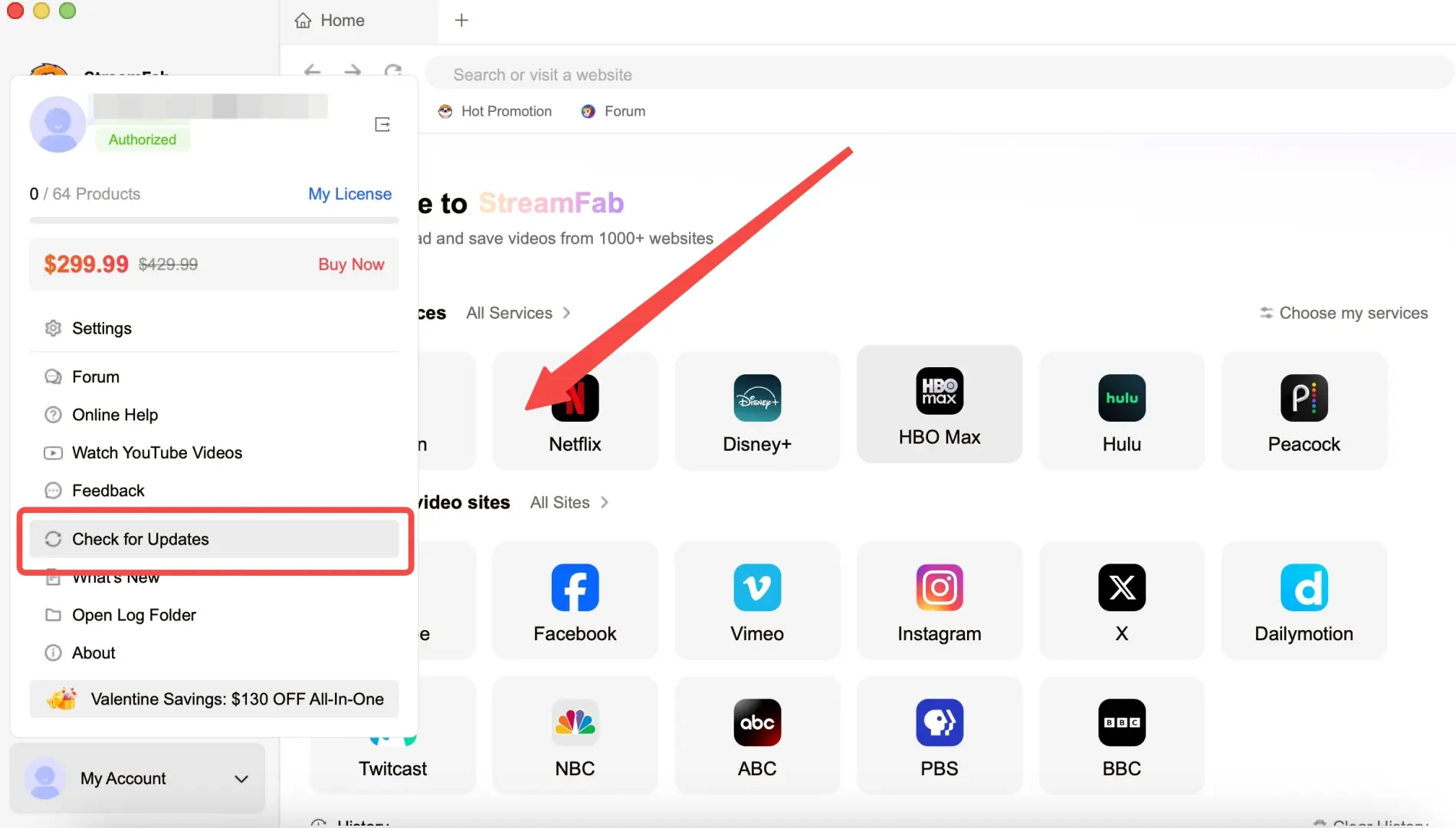
After updating, use the error-code table above to match Error 909 or Error 10201 with its first controlled test.
Test Another Resolution or Format
4K, 1080p, H.264, and H.265 availability varies by platform and release. Use one lower tier or alternate codec as a controlled test, then follow the compatible-build guidance instead of assuming a future patch will restore access.
For a separate 4K workflow, the StreamFab 4K download guide keeps platform-specific quality details in one place.
If a lower tier or alternate codec succeeds after the original setting fails, the download engine is responding and the variable is platform-specific quality or format access.
Service-Specific Checks

Netflix, Amazon, and Peacock can fail for different title, login, or quality reasons. For each branch, keep the test small: browser playback, one alternate title or quality, then the current platform patch notice.
- Netflix. Confirm the title plays in a regular browser with the same account, try another episode or a lower quality tier, and check the current Netflix compatibility notice before changing local settings.
- Amazon. Recheck account sign-in and regional title playback in the browser, test one alternate title or quality, and apply the current Amazon patch guidance if the same code returns.
- Peacock. Verify browser playback and account access, try another title or quality option, and check for a current Peacock service change before repeating cache or network resets.
Reinstall When Updates Fail
If an update loops, the installation may be incomplete. Preserve any settings you need, uninstall the current build, and use the official StreamFab download or StreamFab offline installer for a clean recovery.
When the Problem Is on StreamFab's Side
As of September 2, 2026, a visible engine notice should be treated as a service-side signal first. Check the status/update notice and last compatible build before repeating local resets.
What Download Engine Unavailable Means
“Download Engine Unavailable” means the platform pipeline is being tracked as unavailable for the affected service. It can follow a platform change and appear across builds, so local storage or VPN changes are not the first response.

- "Download Engine Unavailable" The affected platform pipeline is unavailable on the service side; check the status notice and compatible build before local resets.
- "A fix is available — please update" A compatible patch is available; install it, restart StreamFab, and rerun one controlled title test.
Download Versus Analysis Stage
Analysis and download are separate stages. If StreamFab cannot detect the video, use the StreamFab cannot analyze guide; if analysis succeeds but transfer fails, keep using the download-stage tests on this page.
A visible download-engine notice points to the platform pipeline. With no notice, reproduce the failure locally and submit the exact code and logs through the StreamFab log-submission guide so the issue can be classified by stage.
Frequently Asked Questions
Conclusion
When StreamFab cannot download, the reliable path is a sequence: verify title playback, check status, refresh service and StreamFab sign-in, clear temporary state, map any code, and only then change network, storage, queue, quality, or installation settings.
For a StreamFab Mac download, the same stage checks apply with macOS-specific path and permission names. StreamFab Android download follows a separate app workflow, so keep mobile troubleshooting distinct from this Windows and Mac desktop path.
In a Netflix LDR S4 E3 sample on macOS at 24 Mbps, the recorded output was 1080p HDR10 with Dolby Atmos or DD+5.1 at about 538.6 MB; that kind of observable output check helps distinguish a transfer problem from a playback or packaging problem.
If the controlled tests still fail, submit the reproducible log and exact code through the log-submission guide. If you want to validate your own setup, the StreamFab free plan options provide a bounded way to try core functionality before committing to a larger queue.
→ How to find and submit your StreamFab logs Step-by-step instructions for Windows and Mac, including where to find log files and what to include in a support request.